All blogs
AI App Development
Retention Offers vs. Product Fixes for AI App Churn
Match interventions to churn causes: use discounts for price issues, product fixes for AI failures, and billing recovery for payment errors.
10 min read

Retention Offers vs. Product Fixes for AI App Churn
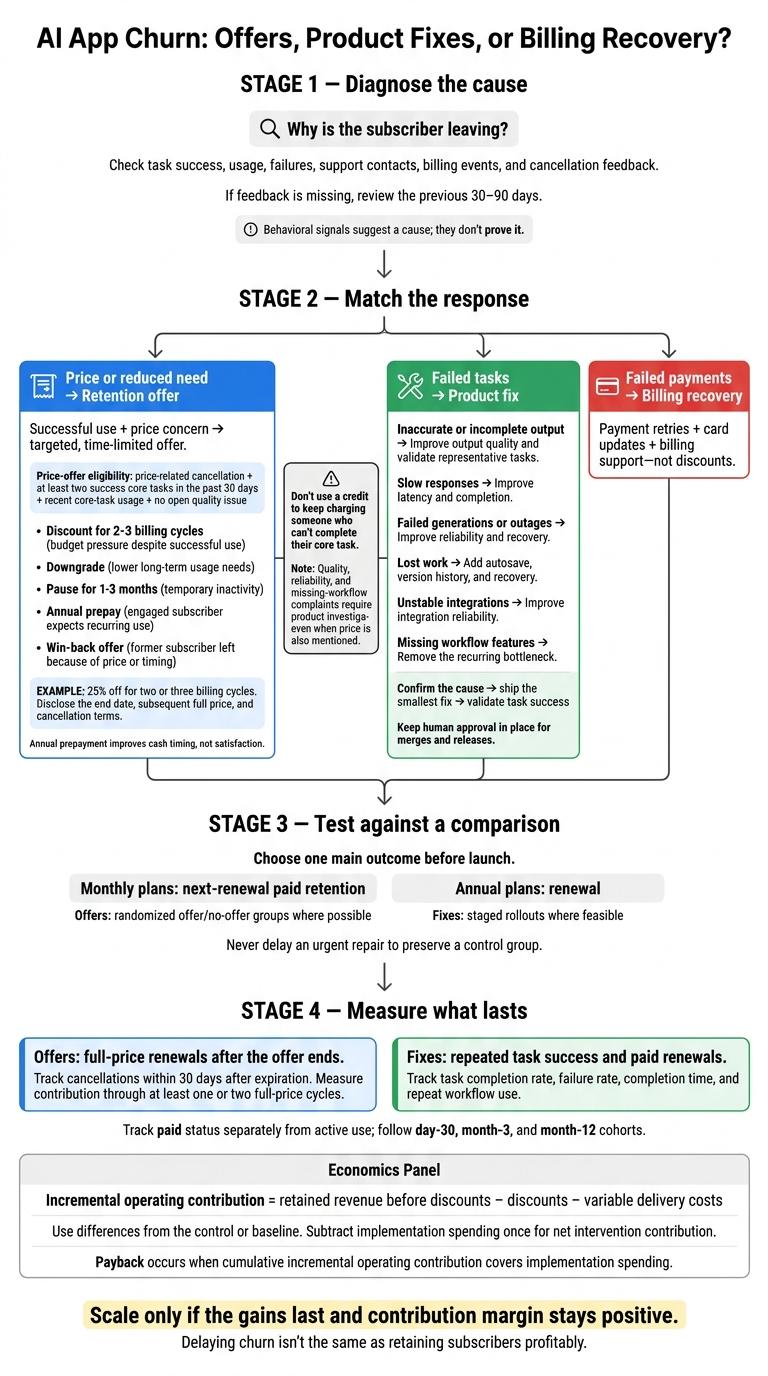
I’d use a discount for a price problem - not a broken AI workflow. Before offering 25% off for 2–3 billing cycles, I’d check whether the subscriber is completing tasks or leaving after errors, delays, or missing features.
Here’s how I’d choose:
- Price or reduced need: Test a discount, downgrade, pause, annual prepay, or win-back offer that fits the subscriber’s needs.
- Poor results or failed workflows: Fix output quality, speed, reliability, lost work, or integrations.
- Failed payments: Use payment retries, card updates, and billing support - not discounts.
Quick Comparison
| What I’d compare | Retention offers | Product fixes |
|---|---|---|
| Best fit | Subscribers who get results but question the cost | Subscribers who can’t finish their tasks |
| Main cost | Discounts and continued service costs | Development, testing, and service costs |
| Proof it works | Full-price renewals after the offer ends | Repeated task success and paid renewals |
I’d test against a control group where possible and track retention alongside delivery and support costs. My rule: <u>measure what lasts</u>. A renewal during a discount is not yet proof of a lasting, profitable save.
Reducing Churn in SaaS Companies (Ep #14) | The SaaS Academy Podcast
sbb-itb-622dc24
Retention Offers: Help Subscribers With Price Concerns
When price is the confirmed reason for churn, use a retention offer to ease the cost concern by changing price, billing timing, plan level, or subscription status.
Match Offers to Subscriber Needs
Ask one cancellation question, then show an offer that fits the answer. Offer a downgrade for lower long-term usage needs and a pause for temporary inactivity. Before the subscriber accepts, explain changes to access, usage limits, billing, and renewal terms.
| Offer type | Best-fit churn reason | Expected behavior change | Margin risk | When not to use it |
|---|---|---|---|---|
| Discount for 2–3 billing cycles | Budget pressure despite successful use | Continued use during a short price test | Lower revenue; dependence on discounts | Poor AI results or unreliable service |
| Downgrade | Lower long-term usage needs | Continued use at a suitable service level | Lower revenue; support costs may remain | A lower tier still cannot complete the required task |
| Pause for 1–3 months | Travel, seasonal work, or temporary inactivity | Return when the need resumes | Forgone near-term revenue; subscriber may not return | Lasting dissatisfaction or loss of need |
| Annual prepay | Engaged subscriber expects recurring use | Upfront payment and fewer monthly renewal decisions | Discount risk, refunds, hidden disengagement | Uncertain value or unresolved product issues |
| Win-back offer | Former subscriber left because of price or timing | Reactivation with a defined incentive | Discount cost and short-lived reactivation | Unresolved output, reliability, or workflow failures |
Annual prepayment improves cash timing, not satisfaction. It collects 12 months upfront and reduces monthly renewal decisions. Track monthly usage, successful tasks, refunds, and anniversary renewals. An inactive prepaid account can hide future churn.
Set Offer Eligibility and Check Full-Price Renewals
Start with a simple eligibility rule: price-related cancellation + at least two successful core tasks in the past 30 days + recent core-task usage + no open quality issue. Check the subscriber’s discount history, too.
Test a clearly disclosed offer, such as 25% off for two or three billing cycles, showing the end date, subsequent full price, and cancellation terms before acceptance.
Send quality, reliability, and missing-workflow complaints to the product team for investigation, even when the subscriber also mentions price.
Compare eligible subscribers who receive the offer with a similar no-offer control group. Track the first full-price renewal separately, cancellations within 30 days after expiration, and contribution margin through at least one or two full-price cycles. Include model usage and support costs. If a subscriber leaves as soon as the discount ends, that’s delayed churn - not a lasting save.
When churn follows poor output, slow responses, downtime, or missing workflows, focus on product fixes instead of deeper discounts.
Product Fixes: Improve AI Results, Reliability, and Workflows
A product fix helps subscribers complete a task accurately, reliably, and repeatedly. That might mean better AI output, fewer failed generations, saved work, or an export or automation step that was missing. Use the table below to connect each symptom to a likely product change.
Match Task Failures to Product Changes
Start with what the subscriber wanted to do. Connect that task to session events, support tickets, cancellation feedback, and interviews.
Behavioral signals suggest a cause; they don't prove it. Retries can mean someone is trying different approaches. Abandonment can mean they got interrupted. Compare failed and successful workflows, then check the suspected cause through interviews, task-level checks, or controlled tests.
| Symptom | Behavioral signal | Likely root cause to investigate | Product response |
|---|---|---|---|
| Inaccurate or incomplete output | Repeated retries, edits, regenerations, copy-paste into another tool, or abandoned tasks | Weak prompting, retrieval gaps, poor context handling, unsuitable model, or unclear output requirements | Improve context collection, prompt and model routing, grounding, and structured outputs; validate against representative test cases |
| Slow responses | Longer completion times, timeout events, or abandonment before completion | Model latency, queueing, oversized context, slow tools, or inefficient streaming | Add streaming, progress states, timeout handling, caching, smaller-model routing, and latency budgets |
| Failed generations or outages | Error spikes, repeated reloads, and sudden drops in task completion | Provider failures, rate limits, deployment regressions, or weak fallback behavior | Add retries with backoff, provider fallbacks, clearer error recovery, monitoring, and incident alerts |
| Lost work | Drafts reopened from scratch, duplicate submissions, or recovery requests | Missing autosave, synchronization failures, session expiration, or destructive navigation | Add autosave, version history, recovery flows, idempotent writes, and visible save status |
| Unstable integrations | Reconnects, failed imports or exports, and workflow abandonment after authorization | Expired credentials, schema changes, rate limits, or incomplete integration coverage | Improve token refresh, validation, error messages, retry handling, integration monitoring, and compatibility tests |
| Missing workflow features | Frequent manual workarounds, exports to other tools, or repeated feature requests | Missing export, collaboration, history, approval, or automation capability | Map the end-to-end job and add the smallest feature that removes the recurring bottleneck |
Once you've confirmed the likely failure mode, define success for each core workflow and measure it from the first sessions.
Measure Task Success in Early Sessions
Define success for each core workflow before reviewing the first several sessions. Track task completion rate, failure rate, completion time, and repeat workflow use - not just prompts. Pair completion events with outcome events, such as an export, share, save, approval, publication, or completion in a downstream system.
Separate confusion from gaps in what the product can do. If guidance resolves the failure, improve onboarding. If adequate inputs still produce poor results, investigate the product itself.
Set priorities based on severity, frequency, the number of affected subscribers, and expected retention impact. Test representative workflows before release. After release, monitor quality, errors, and latency by workflow and model version.
Once the cause is clear, ship the smallest fix that removes the bottleneck.
Ship Focused Fixes With Human Review
Appeneure can turn churn findings into scoped issues with reproduction steps, acceptance criteria, and a rollback plan. Each change should pass code review, automated checks, and human validation on representative workflows. Keep human approval in place for merges and releases. Track task success, reliability, retention, and margin together.
Retention Offers vs. Product Fixes: Choose and Measure Your Test
Once you’ve identified the likely cause, choose the smallest test that addresses it.
Use Churn Reasons and Behavior to Choose a Test
Let the strongest behavioral signal guide your first test. If feedback is missing, review the previous 30–90 days of usage, failures, support contacts, billing events, and cancellation timing. Segment subscribers by plan, tenure, billing cycle, prior usage, and churn reason so you don’t mix different needs together.
| Churn reason | Observed behavior | First intervention to test | Primary hypothesis | Exclusion criteria |
|---|---|---|---|---|
| Price concern | Regular use, cancellation near renewal | Targeted, time-limited offer | Lower price preserves a healthy subscription | Repeated failures, unresolved defects, or little meaningful use |
| AI quality | Corrections, rejected outputs, abandoned tasks | Product-quality fix | Better results restore recurring use | Price-only objection or no remaining need |
| Reliability or latency | Timeouts, failed jobs, slow completion | Reliability fix | Dependable completion improves renewal | Administrative cancellation |
| Missing workflow | Workarounds or abandonment at the same step | Focused workflow fix | Closing the gap restores end-to-end value | Requests outside the target customer or product scope |
| Reduced need | Falling usage without product complaints | Pause or downgrade | Lower commitment preserves the relationship | Unresolved product dissatisfaction |
| Payment failure | Failed renewal charge or expired payment method | Billing recovery | Restoring payment retains a willing subscriber | Explicit voluntary cancellation |
Use a temporary offer only when a verified fix already has an owner, a schedule, and a defined delivery window. Give the offer a fixed end date. Don’t use a credit to keep charging someone who can’t complete their core task.
Once you’ve chosen the intervention, set up a clear comparison to isolate its effect.
Use Control Groups and Track Retention Over Time
Randomly assign eligible subscribers to offer and no-offer groups when possible. For fixes, use staged rollouts where feasible. Add fix-only and combined groups if your sample size allows.
Keep other pricing variables constant, and balance groups by plan, tenure, billing cycle, prior usage, and churn reason. Never delay an urgent repair to preserve a control group. If you compare results with a baseline or untreated cohort, document seasonality, incidents, pricing changes, and differences in customer mix.
Choose one main outcome before launch: next-renewal paid retention for monthly plans or renewal for annual plans. Track paid status separately from active use, then follow day-30, month-3, and month-12 cohorts.
Also track voluntary and involuntary churn, task success and frequency, errors, latency, offer acceptance, post-offer cancellation, and full-price renewal. Include gross revenue retention (GRR), which excludes expansion and reflects churn and downgrades. An early renewal lift doesn’t show lasting success if usage drops away or cancellations spike when the discount ends.
Next, translate the retention lift into margin.
Calculate Incremental Contribution and Payback
Compare both interventions over the same period. Offers usually take less work to implement but reduce revenue right away. Fixes require diagnosis, engineering, and testing, but may help retain subscribers at full price for longer. Neither guarantees faster payback.
Calculate:
Incremental operating contribution = retained revenue before discounts − discounts − variable delivery costs
For each amount, use the difference from the control or baseline. Include added model calls, storage, payment processing, and human review - not just discounts. Subtract implementation spending once to calculate net intervention contribution. Payback occurs when cumulative incremental operating contribution covers that spending.
Report cohort totals, contribution per eligible and retained subscriber, retention lift, and uncertainty. For annual prepayments, separate cash received from revenue earned over the service period.
Conclusion: Retain Subscribers While Protecting Margins
Match your response to the cause of churn: use offers for price-sensitive subscribers, product fixes for poor AI output, reliability issues, or missing workflows, and billing recovery for failed payments.
Test one intervention at a time with a clear success threshold. Before launch, set the minimum retention lift and payback period.
Scale only if the gains last and contribution margin stays positive. Check whether subscribers renew at full price after discounts end and repeatedly complete tasks after fixes ship. Delaying churn isn’t the same as retaining subscribers profitably.
FAQs
What if subscribers cite both price and poor AI results?
Treat this as a sign that users aren’t seeing enough value in your product. Discounts alone may hide quality problems. Fix the technical causes and use targeted incentives to help retain subscribers.
Compare AI outputs with user feedback to spot errors or gaps in users’ workflows. Have human reviewers set quality benchmarks, then use their findings to refine prompts and models. As reliability improves, offer personalized pricing or promotions to bring subscribers back.
How can I test retention changes with few subscribers?
When you have few subscribers, prioritize user feedback over large-scale A/B testing. Use surveys, feedback buttons, and support tickets to group reasons for churn, such as bugs, missing features, or UX issues. Ask domain experts to review examples from actual users to set a baseline.
Test changes with feature toggles and phased rollouts. Track Day 1, Day 7, or Day 30 retention to see whether fixes or offers address the root causes of churn.
How do I prioritize product fixes on a tight budget?
Start by combining user feedback and performance data to spot bugs, missing features, and points where users get stuck. Use RICE or the Kano Model to prioritize fixes based on their potential to improve retention and the effort required. Test changes through MVPs or phased rollouts before committing a large budget.
Use AI-powered tools to automate routine maintenance. Reserve expert review for critical or complex cases to get more from your budget.
More from the studio