All blogs
AI App Development
Australia AI Call Recording: State Consent Rules
State-by-state guide to Australian AI call-recording consent—who must consent, AI use limits, and interstate controls.
16 min read
Australia AI Call Recording: State Consent Rules
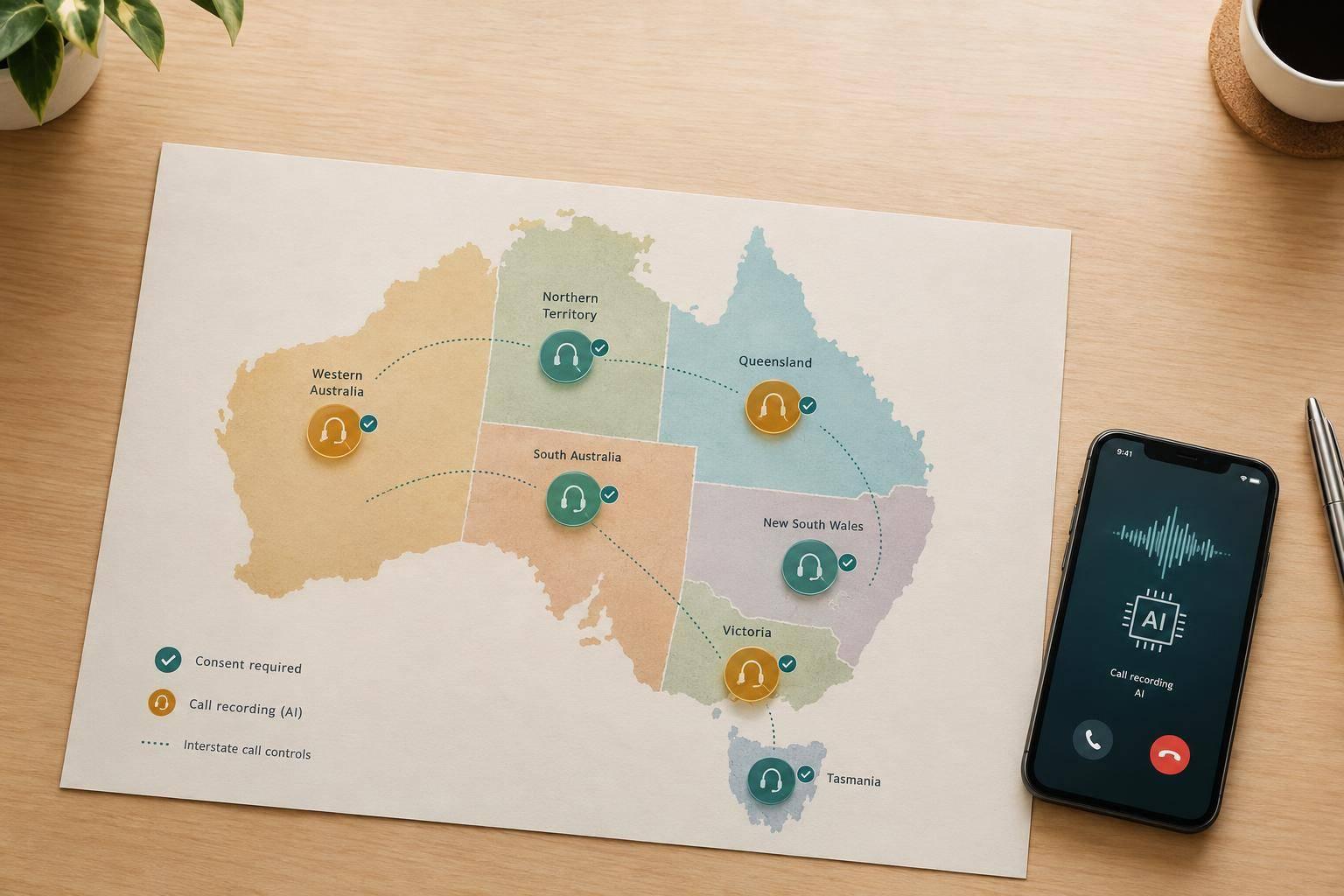
Microphone permission isn’t legal consent to record a call. My default for Australian interstate calls: get everyone’s affirmative consent before recording, explain the AI uses, and offer a non-recorded option. That’s a product policy - not a rule that applies to every call.
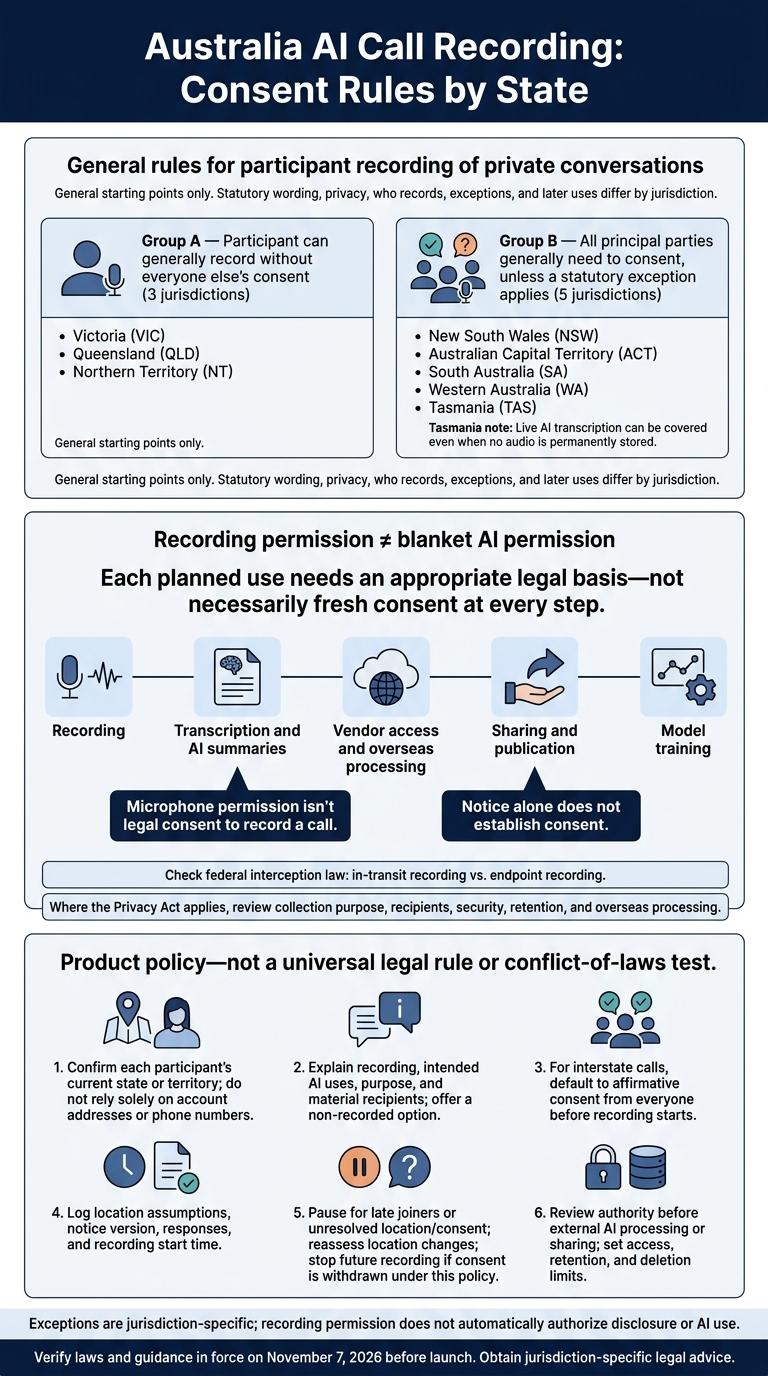
Across Australia’s 8 states and territories, the general rules for recording a private conversation differ:
- Victoria, Queensland, and the Northern Territory: A participant can generally record without everyone else’s consent.
- New South Wales, the ACT, South Australia, Western Australia, and Tasmania: All principal parties generally need to consent, unless a statutory exception applies.
Quick Comparison
| Jurisdictions | General participant-recording rule | Later sharing and AI use |
|---|---|---|
| Victoria, Queensland, Northern Territory | One participant can generally record | Check separately; rules differ |
| NSW, ACT, South Australia, Western Australia, Tasmania | All-party consent generally required | Check separately; recording consent is not blanket permission |
I treat <u>recording and later use as separate legal checks</u>. Transcription, summaries, vendor access, overseas processing, and model training need review under the relevant state rules and, where applicable, federal privacy law. Federal interception law also matters - especially where audio is recorded in transit rather than at an endpoint.
Before launch, I would confirm participant locations, log consent, test withdrawal and late-joiner controls, and set access and deletion limits. The framework also needs checking against laws and guidance in force on November 7, 2026.
1. New South Wales
NSW has strict consent rules, with narrow exceptions that depend on the facts.
Participant Consent
Section 7 of the Surveillance Devices Act 2007 (NSW) generally prohibits knowingly using, installing, maintaining, or causing a listening device to be used to record a private conversation - even if you’re a participant. Get express or implied consent from everyone before recording starts. Whether a conversation is private depends on the circumstances and participants’ reasonable expectations of being overheard.
Statutory Exceptions
With one participant’s consent, recording may be allowed if it is reasonably necessary to protect that participant’s lawful interest. It may also be allowed if the recording is not made to communicate or publish the conversation - or a report of it - to third parties.
These exceptions are narrow. Document the specific interest and why recording is needed; a possible dispute alone is not enough.
Disclosure and AI Processing
Permission to record does not automatically permit later uses. The Act separately restricts possessing, communicating, or publishing records of private conversations, subject to exceptions.
Do not assume a recording exception also permits external AI processing, including transcription or summarization. Check the legal basis for vendor access and transcript sharing, and explain these uses when seeking consent. Uploading audio or sharing transcripts can defeat the exception if the material reaches third parties.
Cross-Border Controls
Interstate calls need controls that account for participants’ locations. For NSW calls, collect each participant’s current state or territory - not just their account address. If locations or applicable rules are uncertain, keep recording off until everyone affirmatively agrees.
Stop recording when someone joins or withdraws consent. Log the selected jurisdiction policy, notice version, responses, and recording start time. Treat these as product controls, not as a statement that every interstate call follows the same legal rule.
sbb-itb-622dc24
2. Australian Capital Territory
The ACT takes a consent-first approach, with narrowly worded exceptions.
Participant Consent
The Listening Devices Act 1992 (ACT) generally prohibits recording a private conversation unless an exception applies. The consent exception requires agreement from each principal party, not just the person starting the recording. Get express consent from every principal party before recording begins. On group calls, identify all participants and get each person’s agreement before turning on recording.
Statutory Exceptions
Under section 4(3), a participant may record if they reasonably believe it is necessary to protect a lawful interest. A separate exception applies if the recording is not made to communicate or publish the conversation - or any report of it - to nonparties. Document the specific basis before recording. The lawful-interests exception does not cover device use by or on behalf of the ACT government.
Disclosure and AI Processing
Permission to record does not automatically authorize external AI processing or sharing. Establish separate consent or other legal authority for external transcription, summaries sent to nonparticipants, and vendor access. Disable model training by default. Do not treat the no-third-party disclosure exception as permission to upload audio to an AI service.
Cross-Border Controls
For interstate calls involving the ACT, do not rely solely on the other jurisdiction’s rule. Check participants’ current locations. When the applicable law is uncertain, make express consent from all parties the default.
Test that a late arrival triggers a recording pause and receives a notice. Log the notice version and consent responses, and block external AI processing unless separately authorized. These controls also support the federal interception and privacy checks that follow.
3. South Australia
South Australia takes a stricter, consent-first approach.
Participant Consent
The Surveillance Devices Act 2016 (SA) generally requires consent from all principal parties before recording a private conversation. Get an affirmative response before recording - don’t rely on silence or boilerplate terms.
Statutory Exceptions
A participant may record without everyone’s consent if it is reasonably necessary to protect that participant’s lawful interests. This is an objective test that depends on the facts of each case. A separate public-interest exception allows use of a listening device when the public-interest test is met.
Disclosure and AI Processing
South Australia separately restricts the use and disclosure of surveillance material. Permission to record does not automatically permit transcription, AI processing, disclosure, or publication. Check the legal authority for each planned use and limit access. Set separate retention and deletion rules for audio, transcripts, summaries, and derived analytics.
Cross-Border Controls
For calls involving multiple jurisdictions, follow the strictest applicable state rule. Confirm participants’ current locations, provide the required notices, get affirmative consent from all principal parties, and log that consent. Don’t assume South Australia’s implied-consent rule meets another jurisdiction’s requirements. If a participant’s location or the applicable law is unclear, pause recording or switch to a non-recorded mode.
4. Western Australia
Western Australia follows a consent-first rule, with narrow exceptions.
Participant Consent
Under the Surveillance Devices Act 1998 (WA), get clear consent from every participant before recording a private conversation. The app should identify everyone on the call - not just the customer account holder - and explain that the call will be recorded and processed by AI. Consent may be express or implied, but notice alone does not prove valid consent.
Statutory Exceptions
WA provides separate lawful-interest and public-interest pathways. The public-interest pathway requires express or implied consent from a principal party, plus a reasonable public-interest basis. Routine product use is not an exception. Have WA counsel review any proposed reliance on an exception before recording begins. These limits make WA unsuitable for routine silent recording.
Disclosure and AI Processing
WA also restricts communicating or publishing a private conversation, including a report or record of it. Treat transcripts, summaries, quotes, and output logs that contain conversation content as regulated copies of that conversation. Before sending audio to an AI provider, verify the legal basis for disclosure and storage, prohibit secondary use or model training, and maintain links between each recording and its AI-generated outputs.
Cross-Border Controls
Using a service provider does not bypass WA’s consent rules. For interstate calls, check each participant’s location - not the provider’s registered address - and disable recording when a participant’s location is unknown. Send uncertain cases for human or legal review.
5. Victoria
Participant Consent
Victoria is the first jurisdiction in this section to allow participant-only recording. But disclosure rules still limit what the app can do afterward. Section 6 of the Surveillance Devices Act 1999 (Vic) allows a participant in a private conversation to record it without notifying the others. Someone who is not a participant generally needs every party’s express or implied consent, unless an exception applies. Permission to record does not cover later disclosure or AI processing.
Statutory Exceptions
Section 11 generally restricts communicating or publishing a recording or report of a private conversation. Exceptions include consent from every party, legal or disciplinary proceedings, and disclosure reasonably necessary in the public interest or to protect the discloser’s lawful interests. Commercial convenience alone does not meet that test. Downstream AI use therefore needs its own compliance check; permission to record does not automatically permit it.
Disclosure and AI Processing
Treat transcription, summaries, and vendor access as disclosure unless an exception applies. This includes internal staff access to summaries. Keep separate consent controls for recording, AI processing, sharing, and model training. Assess any applicable duties under the Privacy Act 1988 separately.
Cross-Border Controls
Despite Victoria’s participant-only recording rule, default to all-party consent for interstate calls. Verify each participant’s current location rather than relying on account details. Pause recording until a late joiner consents, and log consent withdrawals. Test transfers and consent withdrawals - not just the initial connection. These controls also apply to the federal interception and privacy checks that follow.
6. Queensland
Queensland allows more latitude when recording a conversation, but section 45 places tighter limits on disclosure and AI reuse.
Participant Consent
Section 43 of the Invasion of Privacy Act 1971 (Qld) generally lets a participant record or monitor a private conversation without notifying the others. A breach can carry 40 penalty units or 2 years’ imprisonment. Someone who is not part of the conversation generally cannot record it unless a statutory exception applies.
Statutory Exceptions
Section 45 separately restricts sharing or publishing a recording - or any statement derived from it - with another person. Exceptions cover communication to another party, consent from the relevant parties, and legal proceedings. They also cover disclosures no more than reasonably necessary for the public interest, a legal duty, or the protection of lawful interests, as well as reasonable disclosure to someone with a sufficiently connected interest. These exceptions depend on the facts. They do not give blanket permission for routine business use.
Disclosure and AI Processing
For AI voice apps, the main risk comes after recording: vendor uploads and sharing AI summaries remain subject to section 45. Before turning on uploads or automatic exports, document which exception applies and limit who can receive the material. Turning audio into a summary does not remove the restriction on statements derived from recordings.
If the Privacy Act 1988 applies, treat model training as a separate purpose under APP 6. This distinction matters most for transcription, summaries, and vendor uploads.
Cross-Border Controls
Choose the rule based on each participant’s current location, not their account profile. Apply the strictest applicable consent workflow, give an audible notice before recording, and stop if anyone refuses required consent. Log the locations used, the rule applied, and whether recording was allowed or blocked.
These location checks also inform the federal interception and privacy rules below.
7. Northern Territory
Participant Consent
The NT takes an approach closer to Victoria and Queensland on participant recording. Disclosure still needs a separate review.
Section 11 of the Surveillance Devices Act 2007 (NT) generally prohibits someone who is not a party to a private conversation from using a listening device without every party’s express or implied consent. Participants generally have more latitude to record.
Statutory Exceptions
Exceptions cover lawful warrants, specified law-enforcement operations, and serious, urgent circumstances where reasonable grounds exist to believe recording is in the public interest. Do not rely on emergency or policing exceptions for routine product recording.
Disclosure and AI Processing
Section 15 separately restricts communicating or publishing an unlawfully obtained recording or report. NT guidance also identifies disclosure exceptions for consent, protecting the recorder’s lawful interests, public interest, and certain court-related uses.
Permission to record as a participant does not automatically permit third-party AI transcription or recording. Before turning on cloud transcription or AI analysis, check where the recording came from, who will receive it, and the permitted purpose. Turning audio into text does not remove these obligations.
Cross-Border Controls
For interstate calls, default to notice and affirmative consent from everyone if participant locations are unclear. Explain the AI’s role and processing purpose, log consent, and test call transfers so late joiners cannot bypass consent.
These controls feed into the federal interception and privacy rules in the next section.
8. Tasmania
Participant Consent
Tasmania’s Listening Devices Act 1991 covers real-time recording and listening, including live AI transcription - even when no audio is permanently stored. For participant recording, the default is express or implied consent from all principal parties, with narrow exceptions.
Statutory Exceptions
Section 5 allows participant recording without everyone’s consent only if the consenting participant’s recording is reasonably necessary to protect their lawful interests, or is not made to communicate or publish the conversation - or a report of it - outside the conversation. Personal use does not mean permission for commercial AI processing. Emergency or officer exceptions should not be used for ordinary app workflows.
Disclosure and AI Processing
Meeting section 5’s requirements does not remove limits on later communication or publication. Transcripts and summaries can face the same restrictions if they convey the substance of the conversation. Before sending content to an AI provider or enabling exports, document the basis for disclosure and block exports that lack permission. This matters most when a call crosses state lines or feeds an external AI service.
Cross-Border Controls
Store each participant’s current state or territory and the rule applied. If applicability is uncertain, use the strictest applicable consent rule. Keep recording disabled if a principal party refuses, and send any workflow that relies on participant exceptions for Tasmania-specific legal review. Include these location checks in the same consent logic used in the interstate comparison below.
Comparing Consent, Exceptions, AI Use, and Interstate Calls
These groupings are shorthand, not legal rules. Whether recording is lawful still depends on the statute, whether the conversation is private, who records it, and how the material is used later.
Use this comparison to turn state-by-state rules into product controls.
| Jurisdiction grouping | Participant consent and recording | Statutory exceptions | Disclosure and AI processing | Cross-border controls |
|---|---|---|---|---|
| NSW / ACT | NSW generally requires consent from all principal parties. Assess ACT separately because its statute differs. | Check each statute’s lawful-interest and non-publication conditions. Don’t assume the wording matches. | Permission to record does not automatically permit disclosure or AI use. Privacy duties may apply to each later use. | Obtain affirmative consent when locations differ or are uncertain. Log responses and pause unless consent status is clear. |
| SA / WA | Assess South Australia and Western Australia separately. Compare their consent rules and definitions of private conversations directly. | Apply only the relevant statute’s exceptions. Don’t import NSW wording. | Where covered, apply APP duties for collection, purpose, security, access, and disclosure, including AI transcription and summaries. | Use the stricter applicable requirement as the product baseline for interstate calls or uncertain locations. |
| Victoria / Queensland / NT | Group these for presentation only. Check each statute separately. | Check whether each exception applies and what it permits. Lawful-interest, personal-use, and public-interest pathways are not interchangeable. | Review recording and later uses separately. APP duties may apply even when a recording exception applies. | Recheck consent when someone joins, changes location, or recording resumes. |
| Tasmania | Assess Tasmania separately. Check its consent model and communication rules directly. | Check the exact statutory conditions. An exception allowing recording is not blanket permission to share. | Explain audio recording, transcripts, AI use, storage, vendors, overseas disclosure, and training. Check each use against the collection purpose, consent, or another APP exception. | Keep recording off while location or consent remains unresolved. Log the reason. |
Participant Consent and Recording Notices
Statutory definitions matter more than microphone access. A recording announcement, continued participation, microphone permission, or an AI bot joining a call does not automatically establish effective consent. Explain the recording, transcription, AI analysis, purpose, and material recipients. Give people a meaningful chance to decline or leave.
Personal-Use, Lawful-Interest, and Public-Interest Exceptions
Rely only on exceptions provided by the local statute. NSW’s lawful-interest and non-publication wording does not carry across jurisdictions.
Quality monitoring, business convenience, and model training do not automatically qualify. Check personal-use, public-interest, emergency, and warrant exceptions locally. Permission to record may not permit sharing.
Disclosure, Transcription, and AI Processing
Treat recording, transcription, model training, sharing, and personnel use as separate legal steps. Each needs an appropriate legal basis, though not every step requires new consent.
Where the Privacy Act applies, assess collection purpose, reasonable expectations, sensitive information, recipients, retention, security, and overseas processing. OAIC guidance covers personal information used in AI training, testing, and operation.
Consent Controls for Interstate Calls
Check participants’ current locations, the recording endpoint, and any routed audio path. Phone numbers, IP addresses, and account addresses don’t settle the question.
The approach below is a product policy, not a conflict-of-laws rule. Keep the notice version, response, timestamp, and location assumptions that support each decision.
| Location scenario | Consent action | Recording behavior |
|---|---|---|
| All participants are in a clearly permissive jurisdiction | Give notice, confirm intended AI uses, and obtain consent where policy or another law requires it. | Start only after notice and any required consent. |
| Participants are in different states or territories | Don’t assume the caller’s or business’s state controls. Default to affirmative consent from everyone. | Start after consent is logged. |
| A participant’s location is unknown | Ask for their location or use a counsel-approved conservative fallback. | Keep recording paused until consent status is clear. |
| A new participant joins | Repeat the notice and obtain any required consent before recording their contribution. | Pause or exclude their audio until the check succeeds. |
| A participant changes location | Reassess location, repeat notice if needed, and obtain any newly required consent. | Pause while location or legal authority remains unresolved. |
| A participant withdraws consent | Log the withdrawal and apply the policy for existing material. | Stop future recording under the consent-first policy. |
| Later sharing is contemplated | Check authority for disclosure, recipient access, AI processing, and publication. | Restrict access and block distribution until review is complete. |
State consent rules set the floor; federal interception and privacy law can still change the result.
Federal Laws and AI App Controls
State consent rules set the baseline, but federal interception and privacy law still governs how apps record, store, and share audio.
Interception in Transit vs. Endpoint Recording
The Telecommunications (Interception and Access) Act 1979 is part of the legal review for AI call recording. The key question is where the app records audio: in transit or at the endpoint. This distinction shapes how the app records calls - not just its legal label.
Privacy Act Coverage and AI Data Use
Check whether the Privacy Act 1988 applies before applying the Australian Privacy Principles. OAIC guidance separates notice from consent: giving notice does not mean you have consent to collect data. Treat transcription, storage, sharing, and training as separate compliance decisions.
| Legal question | Applicable trigger | App control |
|---|---|---|
| Is the data stored safely? | Security (APP 11) | Encrypt at rest and in transit; delete audio immediately after transcription. |
| How long is data kept? | Retention (APP 11.2) | Automated deletion workflows; “discard after use” policies. |
Once you confirm coverage, address vendor access, retention, and auditability.
Vendors, Overseas Disclosures, and Data Retention
Before collection begins, review each outside service’s access to data, location, and retention terms. Keep security and deletion controls aligned with your retention policy.
Consent Records, Withdrawal, and Audit Logs
Keep consent records, provide withdrawal controls, and maintain audit trails so changes in permission can be traced.
Building and Testing Consent Controls
Test consent, withdrawal, deletion, and routing flows against the app’s expected recording behavior. Build these controls into planning, development, review, and QA, with human approval gates before release.
Conclusion: Consent-First Design and State-Specific Review
State and territory rules point to two product defaults. Victoria, Queensland, and the Northern Territory generally allow one-party recording. NSW, the ACT, South Australia, Western Australia, and generally Tasmania require all-party consent unless an exception applies.
For app design, treat interstate calls as the highest-risk case. Check participant locations and routing, give clear notice, and get affirmative consent from everyone before recording starts. Include purpose-limited controls and a non-recorded fallback. Don’t assume the recorder’s location determines which rules apply.
Lawful recording doesn’t automatically permit other uses. Disclosure, transcription, and model training each need their own legal basis.
Before launch, verify the applicable state and territory laws and guidance as of November 7, 2026. Get jurisdiction-specific legal advice before relying on any lawful-interest, public-interest, or other exception. Complete this review before release - not after deployment.
FAQs
Which laws apply if I record an interstate call?
Recording an interstate call in Australia means checking both state listening-device laws and federal regulations. Consent rules depend on where the participants are and where the call is recorded. The laws that apply determine whether one participant’s consent is enough or whether everyone must agree to the recording of a private conversation.
Check the rules in each affected state and follow the strictest applicable standard to reduce legal risk.
Does on-device AI transcription change my consent obligations?
No. On-device AI transcription doesn’t remove your legal consent obligations. Applicable privacy laws, such as California’s CCPA, still apply whether processing happens on a device or in the cloud.
Explain what data you collect, provide clear ways to give consent, and let users control their information. As privacy rules change, conduct data protection impact assessments and build privacy protections into every stage of the data lifecycle.
Must I delete past recordings if someone withdraws consent?
Yes, you should let users delete their data, including past recordings, if they withdraw consent. Make privacy settings easy to find and use so users can view, edit, or delete their information. Handle deletion requests within a reasonable timeframe.
Set clear data retention policies and delete information you no longer need. These steps help build user trust, limit the data you keep, and support compliance with privacy regulations like the CCPA.
More from the studio