
All blogs
AI App Development
Memory Allocation in AI-Powered Apps
Explore how memory allocation strategies impact performance and efficiency in AI-powered mobile apps, highlighting static, dynamic, and hybrid approaches.
12 min read
Memory Allocation in AI-Powered Apps
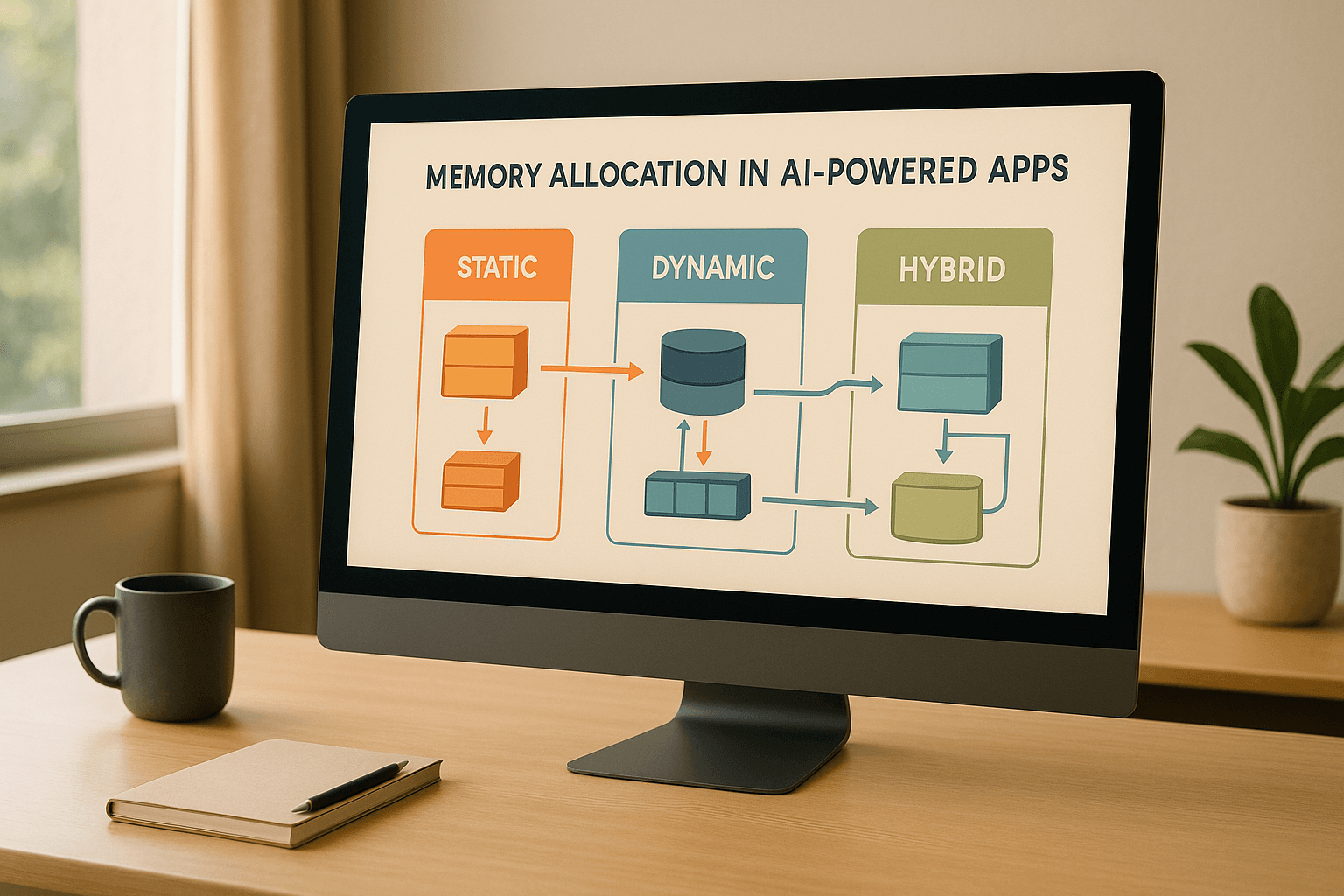
Memory allocation is a key factor in how AI apps function, especially on mobile devices with limited resources. Efficient memory management ensures apps run smoothly, avoid crashes, and conserve battery life. Here's what you need to know:
- Static Allocation: Reserves memory at compile time. Best for tasks with predictable memory needs, like fixed-size AI models.
- Dynamic Allocation: Adjusts memory during runtime. Ideal for tasks with variable inputs, such as natural language processing or real-time analytics.
- Hybrid Approach: Combines both methods to balance performance and flexibility.
Why it matters:
- Poor memory management causes 30% of Android app crashes.
- Efficient memory use can improve app speed by up to 50%.
- Dynamic memory management reduces crashes by 42% in AI apps.
Optimization Techniques:
- Use profiling tools like Android Studio's Memory Profiler or Xcode Instruments.
- Reduce memory fragmentation by batching requests and releasing unused objects.
- Choose allocation strategies based on workload predictability and device constraints.
For mobile AI apps, balancing memory efficiency with performance is crucial. By combining static and dynamic allocation, developers can optimize resource use and ensure a better user experience.
Architecting Agent Memory: Principles, Patterns, and Best Practices - Richmond Alake, MongoDB
Static vs Dynamic Memory Allocation: Core Differences
This section dives into the key differences between static and dynamic memory allocation. Understanding these distinctions is crucial for developers aiming to optimize performance and resource management in their AI applications. Each method comes with its own set of strengths and trade-offs, making it essential to align the choice with the app's specific needs.
Static Memory Allocation
Static memory allocation sets aside a fixed amount of memory during compile time. This method works well for AI applications with predictable memory needs, like image classification models that process standard-sized images. Since the memory is pre-allocated (usually in the stack or data segment), access is quick and consistent. However, there are limitations: over-allocating memory leads to wasted resources, while under-allocating can hinder functionality. Additionally, memory allocated statically cannot be reallocated or reused during the app's runtime.
Dynamic Memory Allocation
Dynamic memory allocation, on the other hand, happens at runtime. Memory is allocated in the heap and can be requested or released as needed. This is especially useful for AI tasks with variable input sizes, such as natural language processing applications that manage anything from short phrases to lengthy documents.
For instance, a study by the University of Michigan found that dynamic memory management in AI-driven Android apps reduced load times by 37% and decreased memory-related crashes by 42%. This shows how runtime adjustments to memory usage can boost performance and make better use of limited resources. However, this approach does come with challenges, including runtime overhead from managing memory allocation and the potential for fragmentation, which can leave portions of memory unusable.
Static vs Dynamic Allocation Comparison
The decision between static and dynamic memory allocation depends on the specific requirements of your application. Below is a summary of the main differences:
| Feature | Static Allocation | Dynamic Allocation |
|---|---|---|
| Speed | Faster execution | Slower due to runtime overhead |
| Memory Efficiency | May waste memory if over-allocated | Optimizes usage but risks fragmentation |
| Predictability | Highly predictable performance | Less predictable behavior |
| Control | Strong compile-time control | Risk of memory leaks or allocation failures |
| Ideal Use Cases | Fixed models, safety-critical systems | Variable tasks, adaptive processing |
For embedded AI systems, such as those used in automotive or medical devices, static allocation is often the better choice due to its predictability and reliability. On the other hand, dynamic allocation shines in AI-powered mobile apps, where flexibility to handle varying runtime demands is a priority. In many cases, a hybrid approach is used to strike a balance between performance and reliability, ensuring the best of both worlds for different AI tasks.
Memory Optimization Techniques for AI-Powered Apps
When it comes to AI-powered apps, managing memory efficiently is more than just picking between static or dynamic allocation. The right choices can significantly reduce fragmentation and improve performance. In fact, advanced AI techniques have been shown to enhance memory management by as much as 80%.
Selecting the Right Allocation Method
Deciding between static and dynamic memory allocation depends on the nature of your app's workload and its performance demands. For workloads that vary, dynamic allocation adjusts memory in real time to meet changing needs.
Take, for instance, an app that processes both small images and high-resolution photos. Dynamic allocation allows the system to assign more memory when dealing with larger files and then free it up when handling smaller ones. This adaptability ensures efficient resource usage.
"Static allocation of resources would undoubtedly result in inefficient resource allocation, adversely impacting execution efficiency." – ScienceDirect
AI-driven systems add another layer of efficiency by predicting workloads in real time. This enables optimized task execution, better CPU utilization, reduced latency, and improved power efficiency. On the flip side, static allocation with rigid configurations can lead to inefficiencies and a frustrating user experience, especially in dynamic environments.
However, while dynamic allocation is flexible, it introduces a new challenge: memory fragmentation.
Reducing Memory Fragmentation
Dynamic memory allocation can lead to fragmentation, where free memory is available but not in contiguous blocks large enough to meet a process's needs. This issue is particularly troublesome in mobile environments, where memory is already limited.
On Android devices, the challenge is compounded by the way the Dalvik heap operates. While it optimizes physical memory by returning unused pages to the kernel after garbage collection, it doesn’t compact memory to close gaps in the logical heap.
"The Dalvik heap does not compact the logical size of the heap, meaning that Android does not defragment the heap to close up space." – Android Developers
To tackle fragmentation, developers can adopt strategies like batching AI model requests, caching frequently used inferences, and dynamically loading or unloading models based on usage patterns. Additionally, for Android apps, releasing unnecessary object references is crucial to free up memory for garbage collection.
With these strategies in place, developers can further refine memory usage by leveraging platform-specific tools.
Using Platform Memory Tools
Both Android and iOS offer robust memory profiling tools that provide real-time insights into how apps use memory and where improvements can be made.
- Android Studio's Memory Profiler: This tool offers detailed, real-time data on memory usage, including heap dumps, garbage collection activity, and memory allocation tracking.
- LeakCanary: A free, open-source library that automatically detects memory leaks during development, making it an essential tool for Android developers.
- Xcode Instruments: For iOS developers, this suite includes tools like Allocations, Leaks, and the Memory Graph to identify and debug memory-related issues.
- Perfetto: An advanced, open-source tool for system-level performance analysis on Android.
To get the most out of these tools, configure them carefully by balancing the level of detail they capture with parsing time. Adjusting intervals and file size limits can help achieve this balance.
sbb-itb-622dc24
Memory Allocation Examples in AI Mobile Apps
Let’s dive into some real-world examples to see how static and dynamic memory allocation strategies are applied to meet the specific needs of AI mobile apps. These cases highlight how these methods align with the unique demands of various AI applications.
Static Allocation for Fixed AI Models
Static memory allocation is a reliable choice for lightweight AI models with predictable memory requirements. These models are often trained using batch learning on complete datasets and remain unchanged after deployment, making their memory usage consistent and easy to manage.
Take the case of replacing a transformer model with a pruned MobileNet. This switch reduced the APK size by 40% while maintaining model accuracy, showcasing the practicality of static allocation for simpler models. Additionally, on-device AI implementations using static allocation achieved a 40% reduction in latency compared to cloud-based solutions.
"Static Memory Allocation: It gives a set amount of memory before execution starts. It is predictable and stable. However, it does not have flexibility. This can cause problems if memory needs to change while running. It is often used in simple AI applications that do not need many changes." – dejaflow.com
Techniques like quantization, which reduces precision from 32-bit to 8-bit, and pruning can shrink model sizes by up to 75% and cut parameters by 30–50%. This not only speeds up inference on mobile NPUs but also makes models more memory-efficient. Frameworks like TensorFlow Lite and PyTorch Mobile are specifically designed for deploying these optimized models on edge devices, offering significant energy savings - up to 50% less energy consumption compared to standard models.
Dynamic Allocation for Variable AI Tasks
Dynamic memory allocation is indispensable for handling AI tasks with fluctuating memory needs. Complex features like natural language processing, real-time analytics, and adaptive machine learning benefit greatly from this flexibility.
Picture a customer service chatbot dealing with conversations of varying lengths and complexities. Dynamic allocation allows the system to adjust memory usage in real time, ensuring smooth performance regardless of the interaction. This adaptability is crucial for maintaining speed, accuracy, and flexibility.
| AI Task Type | Dynamic Allocation Application |
|---|---|
| Streaming Linear Regression | Predicting customer churn in real time |
| Online Random Forests | Detecting fraudulent transactions instantly |
| Incremental Clustering | Identifying emerging customer segments dynamically |
| Real-time Anomaly Detection | Monitoring industrial equipment for failures |
Dynamic allocation also enables systems to adapt to real-time conditions by monitoring CPU usage, memory demand, and network bandwidth. These adjustments ensure optimal performance even under varying workloads.
Appeneure's AI App Memory Optimization

A standout example of memory optimization in action comes from Appeneure, a company known for tailoring memory allocation strategies to enhance both performance and efficiency across mobile platforms.
Appeneure aligns AI model complexity with device capabilities to prevent performance bottlenecks on lower-end devices. For health tech apps, they use lazy loading to load model components only when needed and clear cached data after inference cycles. This approach minimizes RAM usage on devices with limited memory. In e-commerce apps, they leverage platform-specific acceleration APIs - like Qualcomm's Hexagon DSP and Google's Tensor Processing Unit - to improve efficiency on Android devices.
Their work on conversational AI agents highlights the value of dynamic memory allocation. By adapting to variable conversation complexities, they reduced remote server calls by 30%, which in turn boosted user engagement by 15%. Appeneure’s agile testing processes further ensure that their apps perform consistently across diverse device specifications and usage scenarios, whether on iOS or Android platforms.
Memory Allocation Strategy Summary
Choosing the right memory allocation strategy depends on your app's requirements and the constraints of the target device. Deciding between static and dynamic allocation involves several factors that can directly influence your app's performance and usability.
Developer Guidelines for Memory Allocation
To fine-tune your memory allocation strategy, start by profiling and benchmarking your app's memory usage. As an expert from Game Development Stack Exchange aptly puts it:
"The answer to almost every performance question is always 'profile and see'. Hardware is too complex these days to reason about performance from first principles. You need data."
Testing your app under different workloads is essential before making allocation decisions.
Static vs. Dynamic Allocation: The choice between static and dynamic allocation often hinges on the predictability of your data sizes. Static allocation is ideal for AI models or data structures with fixed sizes that remain constant during runtime. For instance, lightweight image classification models or recommendation engines with consistent memory needs are well-suited for static allocation. On the other hand, dynamic allocation is better for scenarios where memory requirements fluctuate or are unknown at compile time.
Object Lifetimes: Static allocation works best for objects with fixed lifetimes, such as those that persist throughout the app's execution. Conversely, objects that are frequently created and destroyed - like temporary tensors in AI inference - can benefit from dynamic allocation. However, dynamic allocation can introduce overhead in these cases, so using memory pools or custom allocators can help optimize performance.
Memory Locality: Efficient memory access is critical for performance. Scattered dynamic allocations can harm data locality, leading to increased cache misses and slower performance. Keeping related data contiguous, whether through static allocation or carefully managed memory pools, can help maintain efficient access patterns.
Minimizing Fragmentation: For mobile AI apps, memory fragmentation is a common issue with dynamic allocation, especially on resource-constrained devices. Techniques like memory pools or specialized allocators can help reduce fragmentation and improve memory management.
Key factors to guide your memory allocation decisions include:
| Allocation Decision Factor | Static Allocation | Dynamic Allocation |
|---|---|---|
| Data Size Predictability | Fixed, known sizes | Variable, unknown sizes |
| Object Lifetime | Constant throughout runtime | Frequently created/destroyed |
| Memory Requirements | Predetermined at compile-time | Adjustable during execution |
| Performance Priority | Slightly faster access | Flexible resource management |
Platform-Specific Considerations: On Android devices, understanding Dalvik/ART heap behavior and garbage collection patterns is essential. Excessive object allocation in tight loops can trigger frequent garbage collection, causing performance slowdowns. Use methods like getMemoryClass() to check available heap space and plan memory usage effectively.
For small, temporary buffers, stack allocation can be a better choice than heap allocation since it avoids the overhead of dynamic memory management. Additionally, in C/C++, using the restrict keyword with dynamic arrays can help compilers optimize access by providing non-aliasing information, reducing redundant pointer fetches in loops.
As one expert notes:
"Dynamic allocation is crucial in programming, because it gives you the flexibility to manage memory efficiently. Instead of wasting resources by pre-allocating memory, you can request it as needed, which is perfect for handling unknown data sizes at runtime."
Finally, avoid premature optimization. Focus on refining your memory strategy only after profiling reveals bottlenecks.
Appeneure's AI Development Services
Appeneure exemplifies these principles in their AI-powered app development practices. Their expertise lies in optimizing memory usage and performance across both iOS and Android platforms.
Their development approach ensures that model complexity aligns with device capabilities, preventing performance issues on lower-end hardware. This strategy delivers a consistent user experience across a variety of devices while maintaining efficient memory usage.
For conversational AI agents, Appeneure employs dynamic memory allocation techniques that adapt to varying levels of conversation complexity. They also implement platform-specific optimizations to enhance performance, particularly on Android devices.
Appeneure's agile development process includes rigorous testing across multiple devices and scenarios. This ensures that the memory allocation strategies they use are reliable and effective, addressing the challenges developers face when optimizing AI-powered apps for mobile environments.
FAQs
How does memory allocation affect the performance and stability of AI-powered mobile apps?
Memory allocation is a key factor in how well AI-powered mobile apps perform and remain stable. When memory is managed efficiently, resources like CPU, memory, and network bandwidth are used wisely. This translates into apps that run faster, operate more smoothly, and deliver a more dependable experience. On the flip side, poor memory management can lead to crashes, sluggish performance, or even apps freezing - issues that can irritate users and erode their confidence in the app.
With AI-driven memory optimization, apps can adjust resource usage in real-time, preventing issues like memory leaks and bottlenecks. This approach not only enhances performance but also ensures the app runs reliably, keeping users happy and paving the way for long-term success.
What are the advantages and challenges of using a hybrid memory allocation approach in AI applications?
A hybrid memory allocation strategy in AI applications uses a mix of memory types, like DRAM and non-volatile memory, to improve both performance and resource efficiency. This setup helps AI systems tackle complex tasks by striking a balance between speed and storage capacity.
That said, this approach isn't without its challenges. It can introduce data transfer delays between memory types, add to system complexity, and require meticulous integration. While it can greatly boost an AI system’s functionality, effective management is crucial to keep latency low and operations running smoothly.
What are some effective ways to reduce memory fragmentation in AI-powered mobile apps?
To tackle memory fragmentation in AI-powered mobile apps, developers can rely on memory pooling. This technique involves reusing pre-allocated memory blocks for frequently used objects, which not only reduces fragmentation but also boosts overall performance.
Another effective strategy is choosing efficient memory allocation methods, like the best-fit algorithm, which helps optimize resource usage by reducing wasted space. On top of that, leveraging AI-driven memory management tools can identify and fix memory leaks, leading to smoother app performance and smarter resource usage.
More from the studio