
All blogs
Uncategorised
Google adds AI agent controls to Chrome DevTools 154
Summary of Chrome 153/154 DevTools updates (Oct 2026): AI agent controls, source inspection, trace recording, and performance tools.
3 min read
Google adds AI agent controls to Chrome DevTools 154
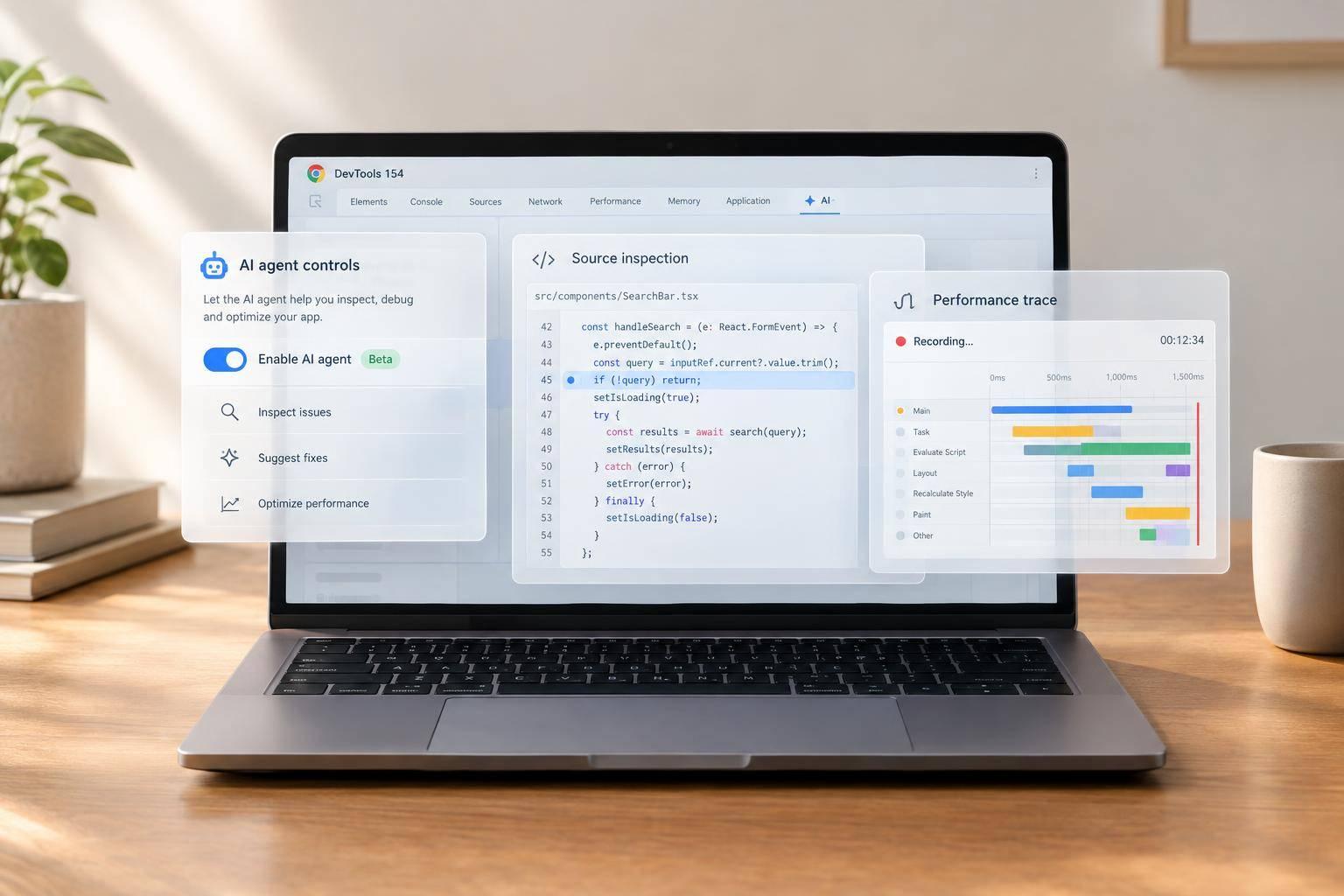
Google is giving AI coding agents more control over debugging live web pages, adding finer JavaScript execution controls to Chrome DevTools alongside tools that let its AI assistant inspect source files and record performance traces.
The changes are part of the Chrome 153 and Chrome 154 stable releases. Google’s Chrome team detailed them in its October 2026 DevTools roundup, published September 22 and updated October 2.
The update extends AI-assisted development beyond writing and reviewing source code into examining how that code behaves in a running browser.
More control over live debugging
According to the official Chrome for Developers blog post, the roundup "highlights fine-grained JavaScript execution controls in DevTools for agents" alongside improvements across several debugging panels.
Google describes the feature as "fine-grained JavaScript execution controls in DevTools for agents", intended to give automated coding tools more precise control during debugging sessions.
The distinction is practical: while editor-side coding tools work with source files, DevTools provides access to a live page. Agents can use that debugging environment to investigate running code rather than relying solely on what they can learn from files.
The release also expands the built-in AI assistant. Per the Chrome team’s own roundup, AI assistance in DevTools "gained source inspection" and "gained performance-trace recording" in this release.
Source inspection allows the assistant to examine files associated with a problem. Performance-trace recording lets it capture runtime information as part of its analysis, reducing the need for developers to record a trace separately before asking for help.
Together, those additions reduce manual handoffs between identifying a problem, locating the relevant code and collecting evidence about how a page runs.
sbb-itb-622dc24
Performance and inspection tools also change
The Performance panel gains full soft-navigation support for page transitions that do not reload the entire document. Those transitions are common in single-page applications, where client-side routing changes what users see without a traditional page load.
The panel also adds CPU performance-tier overrides, allowing developers to simulate different processor performance levels inside DevTools when assessing how a page behaves on slower hardware.
Other changes cover advertising scripts, CSS inspection and responsive testing:
- Application panel: Ad-script tracking helps distinguish scripts associated with advertising from core application code.
- Elements panel: Inactive-style support surfaces CSS rules that are overridden or not applied. Keyboard-accessible adorners make the icons identifying features such as flex containers and grid layouts navigable without a mouse.
- Device Mode: Updated device presets refresh the simulated phones and tablets available for responsive testing.
Google now ships two stable Chrome releases a month rather than one, increasing the pace at which DevTools changes reach developers.
Adoption grows, but trust remains a constraint
The agent-focused changes arrive as AI tools become a routine part of software development.
Stack Overflow found that "84% of developers use or plan to use AI tools in their development process", according to the 2025 Stack Overflow Developer Survey. The same survey reported that 51% of professional developers use AI tools daily.
More specifically, Stack Overflow reported that "31% of developers reported using AI agents", according to its developer survey results analysis.
The source article gives conflicting figures for trust in AI accuracy. It states that the survey found "only 33% of technologists trust the accuracy of the AI tools they use", while elsewhere listing 29%. Which figure is correct is not verified here.
On model use, Stack Overflow found that "82% of developers who used large language models for development work used OpenAI’s GPT models", according to the 2025 Stack Overflow Developer Survey technology section.
Interest also extends to connecting browser debugging tools with agents. According to keyword research data cited in the source, "chrome devtools mcp" draws an estimated 4,400 monthly searches in the US, compared with roughly 8,100 for "chrome devtools." MCP, or Model Context Protocol, provides a standardized way for AI coding agents to call external tools.
Google’s agent controls and AI-assistance upgrades bring more of the debugging process into that automated workflow. The central change is not simply an assistant that explains a problem: it is one with access to the source files and runtime traces needed to investigate it.
More from the studio