
All blogs
AI App Development
EU AI Apps: Privacy Notices vs. AI Transparency Rules
Why GDPR privacy notices don't replace Article 50 AI transparency duties - what app teams must do for disclosures and output marking.
8 min read

EU AI Apps: Privacy Notices vs. AI Transparency Rules
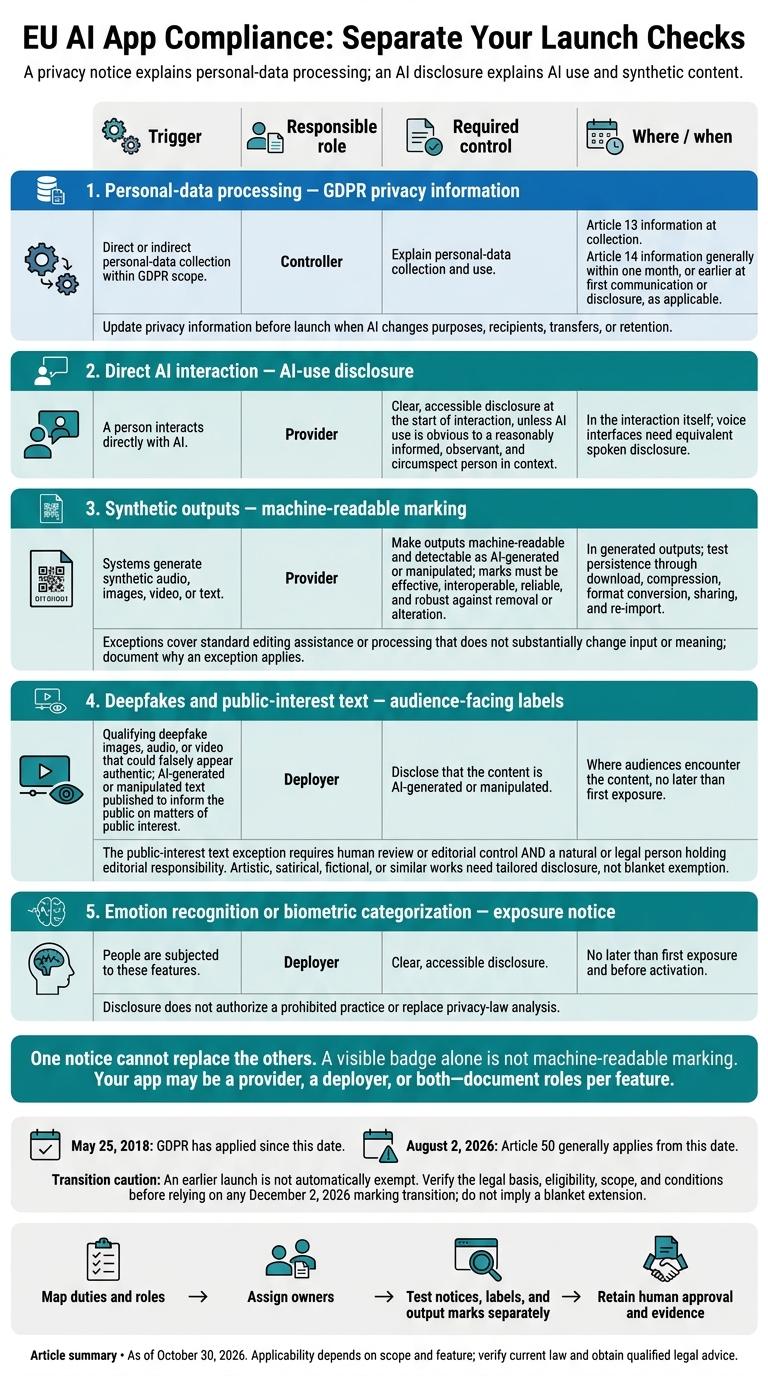
I’d treat your privacy notice, AI disclosures, and output marks as separate launch checks - not one policy update. As of October 30, 2026, GDPR and the EU AI Act can both apply to U.S.-based apps, depending on their scope.
Here’s what I’d check for each feature:
- Personal data: Explain its collection and use through GDPR privacy information.
- AI interactions: Tell users when they’re interacting with AI, unless that is clear from the context.
- Generated content: Check machine-readable marking duties and separate labels for deepfakes and public-interest text.
- Emotion recognition and biometric categorization: Check exposure notices and whether the use is allowed.
GDPR has applied since May 25, 2018; Article 50 generally applies from August 2, 2026. I wouldn’t rely on a December 2 marking delay without checking its legal basis - or assume an earlier launch creates an exemption.
My release checklist: confirm legal roles, assign owners, test notices and exports, and keep proof of human approval. A vendor’s promise isn’t a test result.
EU AI Act Transparency Obligations for AI Systems 2 August 2026 DEADLINE! Article 50 Explained
sbb-itb-622dc24
GDPR Privacy Information vs. AI Act Transparency
GDPR notices explain how personal data is processed. Article 50 requires disclosure of AI use and marking of certain outputs.
These duties can overlap, but one notice cannot replace the other. Contracts can assign tasks, but they do not transfer legal responsibility.
With the GDPR notice requirements clear, the next question is when the AI Act requires in-app disclosure or output marking.
Article 50: AI Disclosures and Output Marking
Providers handle direct-interaction disclosures and technical output marking. Deployers handle notices tied to exposure or publication. Using a third-party model does not settle your role: you may be a provider, a deployer, or both. Document your roles for each feature, including who supplies notices and keeps output marks intact.
Privacy notices explain data processing. Article 50 disclosures explain AI use and generated content. Check which features need user-facing disclosures and which need output marks.
Disclose AI Interactions
Providers must disclose AI use clearly and accessibly at the start of an interaction, unless that use is obvious to a reasonably informed, observant, and circumspect person in context. Voice interfaces need an equivalent spoken disclosure.
A privacy policy should not be your only Article 50 control. A statement buried there may not tell users that the apparent support representative is AI. Check what users actually see or hear - not just whether disclosure text exists somewhere.
If the system generates content, providers must also address output marking.
Add Machine-Readable Marks to Generated Outputs
Under Article 50(2), providers of systems that generate synthetic audio, images, video, or text must make outputs machine-readable and detectable as AI-generated or manipulated. A visible badge alone is not enough. Marks must be effective, interoperable, reliable, and robust against removal or alteration.
Exceptions cover standard editing assistance or processing that does not substantially change the input or its meaning. Not every editor feature qualifies. Record your marking method and the reasoning behind any exception. Test detection after download, compression, format conversion, sharing, and re-import. Investigate exports that strip the signal.
These marks support separate labeling duties for downstream publication and manipulated media.
Label Deepfakes and Public-Interest Text
Deployers must disclose when qualifying deepfake images, audio, and video are AI-generated or manipulated if they could falsely appear authentic. They must also disclose AI-generated or manipulated text published to inform the public on matters of public interest. Put required disclosures where audiences encounter the content, no later than first exposure.
The text exception applies only when the content has undergone human review or editorial control and a natural or legal person holds editorial responsibility for publication. Keep records of that review and responsibility; do not assume any human edit qualifies. For artistic, satirical, fictional, or similar works, use a tailored disclosure rather than treating them as exempt.
Disclose Emotion Recognition and Biometric Categorization
Some AI duties depend on user exposure, not content generation. Under Article 50(3), deployers must clearly and accessibly disclose emotion recognition and biometric categorization features to people subjected to them. Disclose no later than first exposure and before activation; general account terms alone are not enough.
Disclosure does not replace a separate privacy-law analysis or authorize a prohibited practice.
Application Dates and Transition Rules
GDPR Has Applied Since May 25, 2018
Article 13 covers direct collection; Article 14 covers indirect collection. Adding AI can change purposes, recipients, transfers, or retention. Update the notice before launch to reflect those changes.
These dates determine when notice updates, disclosures, and output marks must be in place. The table separates standard notice requirements from special transition rules.
| Date or trigger | Requirement | Who it applies to | Implementation action |
|---|---|---|---|
| Direct or indirect personal-data collection | GDPR privacy information | Controllers within GDPR scope | Provide Article 13 information at collection. For Article 14, generally provide it within one month, or earlier at first communication or disclosure, as applicable. |
| August 2, 2026 | Article 50 generally applies | Providers and deployers covered by each duty | Add required AI disclosures and output marking to release checks. |
| Special transition window for certain large-scale EU IT systems | Article 111(1) transition | Only qualifying systems put into service before August 2, 2027 | Confirm eligibility for the December 31, 2030, compliance deadline. Do not apply this deadline to ordinary apps. |
For app teams, start by identifying which notices need to change before launch.
Article 50 Generally Applies From August 2, 2026
Check the current consolidated text before publishing. Article 111 requires a separate review of existing systems. An earlier launch does not, by itself, establish an exemption.
Record the system category, market-entry date, provider/deployer role, relevant changes, and exact transitional provision supporting any delay. Then map the applicable date to product releases and disclosure gates.
Verify Any December 2 Marking Transition
Do not plan releases around an unverified December 2, 2026, Article 50(2) marking transition. Before relying on it, verify the legal basis, eligible systems, scope, and conditions - including how it treats previously generated content. Do not delay other Article 50 duties without verified authority.
Once the deadline is confirmed, assign each disclosure task to a release owner.
AI App Implementation Checklist
With deadlines set, turn the rules above into four workstreams: GDPR privacy information, AI-interaction disclosures, visible content labels, and machine-readable marking. For each feature, document which duties apply, which don’t, and why. Add a separate exposure-notice task if you use emotion recognition or biometric categorization.
Assign Legal Roles and Task Owners
Document the company’s GDPR role - controller, joint controller, or processor - and AI Act role - provider, deployer, or both - for each activity.
Assign a named owner to each applicable obligation: data-flow mapping, privacy notices, chatbot disclosures, content labels, machine-readable marking, vendor due diligence, testing, and release approval.
Ask vendors to document their marking capabilities, supported formats, retention, training use, processing locations, and deletion procedures. Verify what the implementation does - not just what the vendor claims. Take unclear roles, exceptions, and classifications to qualified counsel.
Test Disclosures and Content Exports
Test every path that can present AI or generated content: onboarding, chat, voice, sharing, downloads, APIs, embeds, support handoff, account deletion, and accessibility features. Make sure AI disclosures appear at first interaction or exposure, including through screen readers and translated interfaces. Check that users can access privacy notices at collection and understand content labels.
Test visible labels and machine-readable marks separately. Check both through resizing, compression, format conversion, downloads, and sharing or publishing flows. A visible “AI-generated” label doesn’t automatically satisfy technical marking duties.
Keep screenshots, sample outputs, metadata checks, detection results, limitations, and change logs. Repeat testing after changes to the model, vendor, interface, prompt, or export format.
After testing, move only approved builds into release.
Require Human Review Before Release
Put every release through a human approval gate. A human-led product team should map data flows, turn legal conclusions into implementation tickets, review code changes, test builds, check device behavior, and approve releases.
Keep the approval trail auditable with issues, pull requests, test results, screenshots, and release records. This process does not determine legal roles or replace qualified legal advice.
Conclusion: Deliver Privacy Notices and AI Disclosures Separately
The two regimes overlap in data use, but they serve different purposes. A privacy notice explains personal-data processing; an AI disclosure explains AI use and synthetic content. Article 50 covers notices about AI interactions, AI-generated or manipulated content, and certain uses of emotion recognition or biometric categorization. It also sets separate technical requirements for marking outputs.
For release planning, Article 50 generally applies from August 2, 2026. Check any December 2, 2026, marking transition against the current rules. Don’t treat it as an extension for all transparency duties. These dates affect product launch gates - not just policy wording.
App teams should map each data flow and keep privacy notices, AI disclosures, and output-marking controls separate, with clear triggers for each. Assign one owner to each duty and retain separate proof of testing before release.
FAQs
Does my U.S. AI app fall under EU rules?
Your U.S.-based AI app may fall under the EU AI Act if it’s placed on the market or put into service in the EU - or if its output is intended for use there. Your company’s U.S. location doesn’t rule out coverage.
Any transparency duties that apply, such as labeling AI-generated content and telling users they’re interacting with a chatbot, are separate from GDPR privacy notice requirements.
Who handles disclosures when I use a third-party AI model?
Your company is still responsible for transparency and privacy compliance, even when a third-party processor handles the data. Your privacy policy must clearly explain how you collect, use, and share user information.
Set clear rules for handling data, and make sure third-party providers agree to the privacy standards and legal obligations in your documentation. Keep people involved in reviewing disclosures and data practices so both stay aligned with regulatory requirements.
What if users remove AI labels before sharing content?
Removing AI labels before sharing content could unintentionally violate transparency requirements. Under the EU AI Act, providers and deployers are responsible for keeping synthetic content, such as AI-generated images or text, clearly labeled.
Developers must build systems with disclosure metadata or watermarks that are hard to bypass. If users remove those labels, the entity deploying the AI system remains responsible for compliance.
More from the studio

