All blogs
AI App Development
Ethical Issues in AI-Powered Team Management
Explains bias, opacity, weak oversight, and wellbeing risks from using AI for scoring, scheduling, and managing teams—and governance checks.
9 min read

Ethical Issues in AI-Powered Team Management
If you use AI to score employees, assign shifts, or guide managers, the main risks are plain: bias, black-box decisions, weak oversight, and more stress at work.
I’d sum up the article like this: AI in team management can save time, but it can also repeat old patterns from past data, hide how decisions are made, blur who is responsible, and push people into constant monitoring. Even when a system looks neutral, it can still affect pay, promotions, schedules, and morale in uneven ways.
Here’s the short version of what matters most:
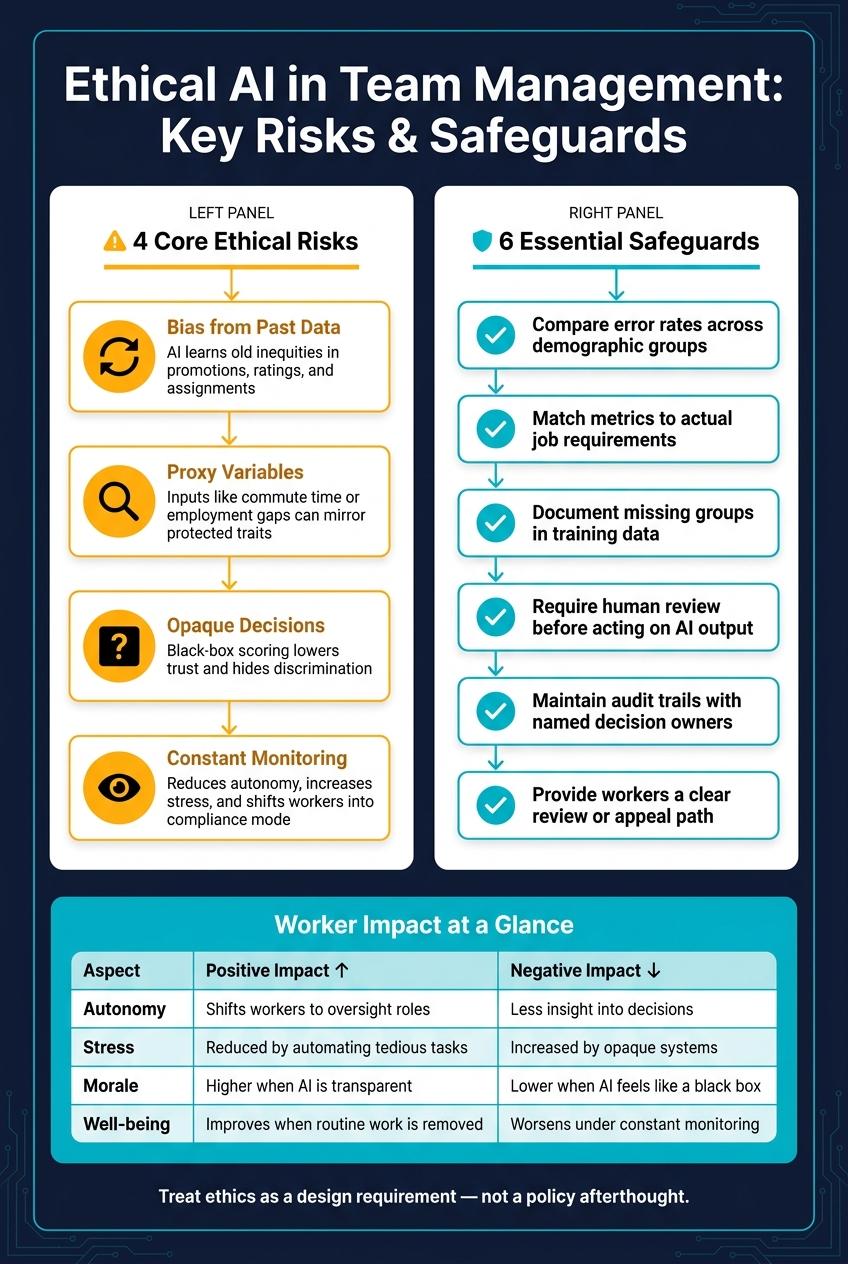
- Bias can enter through past data. Old promotion, rating, and assignment records can teach a model to repeat old patterns.
- Proxy data can still cause harm. Inputs like location, commute time, or work gaps may stand in for protected traits.
- Opaque scoring lowers trust. If people can’t see why they got a score or task, they’re less likely to accept it.
- Human review must be built in. If managers only click “approve,” AI decisions can pass through with little judgment.
- Worker well-being is on the line. Constant tracking can cut autonomy and add pressure, even if some routine work is automated.
A few checks stand out from the research:
- Compare error rates across groups
- Make sure metrics fit the actual job
- Note where training data is missing groups
- Give workers a clear review or appeal path
- Keep audit trails and named decision owners
Bottom line: I see this as a design and management issue, not just a policy one. What you track, how you explain outputs, and where a person can step in will shape whether AI helps your team or boxes people in.
Bias and Fairness in AI-Based Performance Evaluation
AI-based performance tools can make scoring look more even. But the research points to a hard truth: these systems can repeat bias when they learn from biased data or when no one checks their output. And the stakes aren't small. These tools can shape promotions, pay, scheduling, and task assignment.
How Bias Gets Into Team Scoring and Ranking Systems
One of the biggest risks sits in the training data. If a model learns from past promotion decisions, performance ratings, or reward patterns, it can pick up the assumptions buried in those records. In plain English, the system can learn old habits.
Models trained on past promotions, ratings, or assignment patterns can repeat earlier inequities, especially when high-visibility work keeps going to the same people. So even if race, gender, or disability isn't entered into the system, a model trained on an uneven history may still treat some groups less favorably.
Proxy variables add another layer of trouble. A system may avoid using race, gender, or disability status directly, yet still infer patterns tied to those traits through inputs like location, commute time, or employment gaps. On paper, that may look neutral. In practice, it can still lead to biased results.
Ranking systems also tend to favor what is easy to count. That sounds neat and tidy, but work isn't always neat and tidy. Output metrics can miss mentoring, collaboration, and problem-solving support - the kind of work that keeps teams running even when it doesn't show up cleanly in a dashboard.
What Fairness Research Says Organizations Should Check
Research says organizations should look at a few things before trusting these systems too much:
- Compare error rates across groups
- Match the metrics to the actual job
- Document which groups are missing from the training data
- Require human review before a manager acts on the system's output
That documentation matters. It creates accountability and helps managers avoid treating the system as more objective than it is.
These checks matter because biased scoring can look objective while still producing uneven outcomes.
That problem gets even harder to catch when managers can't see how the system reached its score.
sbb-itb-622dc24
Transparency, Explainability, and Employee Trust
AI scores can look objective on the surface. But that doesn’t mean employees will trust them.
People need to see how a score, recommendation, or task assignment was produced. Recent studies connect opaque AI scoring, recommendations, and assignments with lower trust and less willingness to accept the outcome. And there’s another problem: when a system works like a black box, bias gets much harder to spot.
Why Opaque Management Tools Create Resistance
If an employee gets an AI-generated score or recommendation with no clear explanation, they’re stuck. They can’t understand the result, and they can’t push back on it in any useful way.
That’s where resistance starts.
Workers need plain answers to basic questions:
- What inputs does the model use?
- How does it weigh those inputs?
- What triggers a recommendation or a flag?
That kind of clarity makes feedback easier to accept. Without it, the system can feel arbitrary, even when the company believes it is being consistent.
What Meaningful Transparency Looks Like in Practice
Meaningful transparency does not mean dumping technical detail on employees. It means giving enough context to explain the decision in plain English.
Employees should be able to understand what the system is doing, what data it uses, and how to speak up if something seems off. In practice, that looks like this:
| Transparency Dimension | Performance Scoring | Scheduling & Assignment | Feedback Modules |
|---|---|---|---|
| Tell workers when AI is involved | Let employees know scores are AI-generated | Make it clear when assignments are automated | Label feedback as system-generated when applicable |
| Explain outputs in plain language | Explain what the score means | Explain the basis for a shift or task assignment | Explain why a prompt or recommendation appeared |
| State what data is used | Describe the data used to generate the score | Explain what information affects scheduling or assignment | Clarify what information the module relies on |
| Provide a review or appeal path | Offer a review or appeal process | Provide a simple way to ask for clarification or correct errors | Provide a simple way to ask for clarification or correct errors |
The goal is simple: make AI decisions understandable and open to challenge. If employees can’t see how a decision was made, it becomes much harder to tell who is responsible when something goes wrong.
Accountability, Governance, and Human Oversight
Transparency explains how a system works. Accountability answers a different question: who owns the outcome when that system causes harm or leads to an unfair result?
Where Accountability Breaks Down in AI Team Decisions
In AI-driven team decisions, responsibility can get muddy fast. Managers, HR, senior leaders, and outside vendors may all touch the system. Then, when something goes wrong, no one seems fully on the hook.
Part of the problem is how people read AI output. Scores and recommendations often look more objective than they are. That can give them a kind of false authority. A manager may lean on the system and treat its output like a shield: the tool said it, so the blame isn't on me. At that point, human review can turn into a quick box-check instead of a real moment of judgment.
That’s why oversight needs to be part of the workflow from the start, not something added later after the damage is done.
Governance Elements Studies Repeatedly Recommend
Across research and policy frameworks, the same governance tools show up again and again: audit trails, documentation, approval workflows, human review, and ongoing monitoring.
| Governance Component | Ethical/Operational Risk Addressed |
|---|---|
| Audit trails and documentation | Supports accountability when AI-influenced decisions are questioned |
| Approval workflows | Helps ensure important decisions are reviewed before they take effect |
| Human review | Prevents automated decisions from taking effect without sign-off |
| Ongoing monitoring | Helps identify issues that emerge over time |
In higher-stakes settings, human oversight works best when it sits inside the workflow itself. If it only appears at the end as a rubber stamp, it doesn’t do much good.
A Note for AI Product Teams and App Builders
For product teams and app builders, this isn’t just a policy issue. It’s a design issue.
These gaps show up in the small mechanics of a product: workflows, review steps, approval paths, alerts, and defaults. An unexplained AI performance flag is a design choice. An automatic shift change that goes through without human confirmation is also a design choice. Both make accountability weaker.
When those controls are missing, AI can slowly move decisions out of human hands and into the system itself.
Worker Autonomy, Well-Being, and Conclusion
What Studies Report About Monitoring, Stress, and Autonomy
After bias, transparency, and accountability, the next issue is what AI does to day-to-day work.
AI-powered management does not affect every worker in the same way. A lot depends on how the system is built and which metrics it uses.
When tracking is constant and hard to understand, it can create pressure instead of clarity. People may start optimizing for compliance, not judgment. And that changes more than behavior. It changes the job itself.
Research also shows AI moving workers from routine execution into oversight roles. That can be a good shift. It can free teams to spend more time on higher-level planning and decision-making. But that change needs to be explained and backed with support. If it is not, responsibility can drift away from control. Workers are still on the hook for outcomes, yet they may have less insight into how decisions are made.
Poorly set up AI tools can also lead to technical debt, security gaps, and brittle workflows. In that kind of setup, stress does not go down. It goes up. Human review helps keep high-stakes decisions open to challenge.
| Aspect | Impact of AI-Powered Management |
|---|---|
| Autonomy | Moves workers from execution to oversight |
| Stress | Can be reduced by automating tedious tasks, but increased by opaque systems, technical debt, and security gaps |
| Morale | Higher when AI is transparent and reviewable; lower when it feels opaque |
| Well-being | Improves when AI removes routine work; worsens under constant monitoring |
Conclusion: Key Ethical Risks Businesses Should Understand
Taken together, these findings show that ethical risk is also an operating risk. Recent studies point to four connected problems: opaque recommendations, weak oversight, brittle systems, and lower autonomy. Bias shapes outcomes. Opacity makes it harder to question decisions. Weak oversight blurs accountability. And constant monitoring can chip away at worker control.
For U.S. founders and small teams looking at AI features in internal tools or management apps, the takeaway is pretty simple: treat ethics as a design requirement. Early choices matter a lot. What gets tracked, how recommendations are explained, and where human review sits in the workflow will shape whether the system helps people work better or boxes them in.
FAQs
How can companies test AI tools for bias?
Companies should take a systematic approach instead of leaning on automated metrics alone.
Start with human oversight. Have domain experts review actual input-output pairs so they can catch inaccuracies, odd behavior, or unfair patterns that raw scores might miss.
It also helps to use explainable AI so the process is easier to review. Then use A/B testing to compare how models perform in practice, not just in a lab setting.
A simple analyze-measure-improve cycle, backed by human feedback, helps teams refine prompts and models over time.
What should employees do if an AI score seems wrong?
If an AI-generated score or recommendation seems off, employees shouldn't treat it as the final word. They should use the company's feedback channels to flag the issue or question the result.
Organizations should also set clear escalation procedures for reviewing or overriding AI suggestions that clash with human judgment. That way, AI stays a support tool, while people remain responsible for critical decisions.
When should human managers override AI decisions?
Human managers should step in when AI recommendations don't make sense, clash with sound judgment, or touch work that's too complex for the system to handle well.
They should also override AI when the output is wrong, misses key context, or doesn't line up with business goals. The final call still belongs to people.
More from the studio