All blogs
Mobile App Development
Country-Specific ASO Tips for Emerging Markets
Localize keywords, creatives, pricing, and payments by country to increase installs, conversion, and revenue in emerging markets.
11 min read
Country-Specific ASO Tips for Emerging Markets
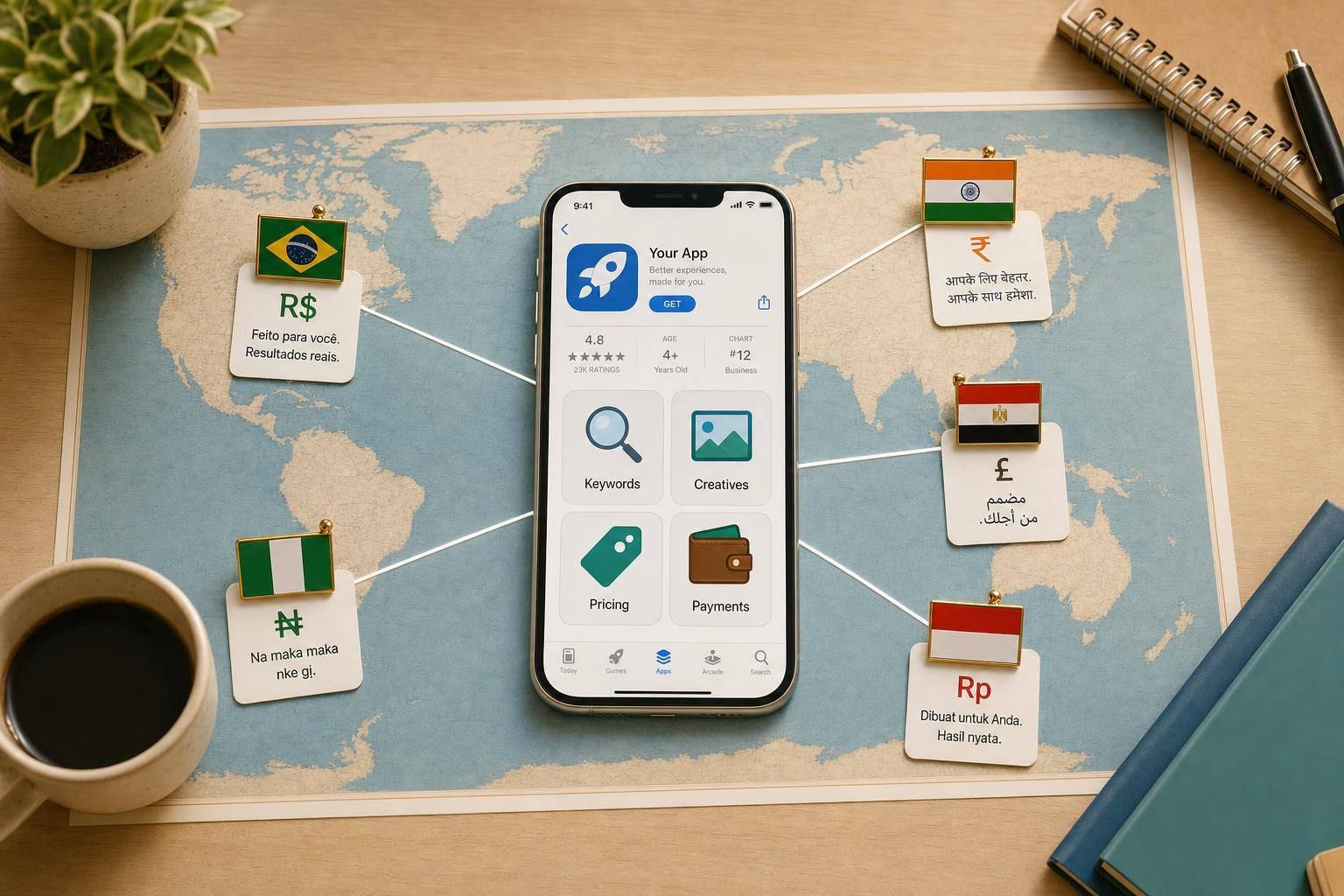
If you use one ASO setup for every market, you will miss installs and revenue. In places like India, Brazil, and Indonesia, search terms, language, phone limits, and payment habits change by country. That matters because these three markets now drive 45% of all Google Play downloads.
Here’s the short version: I’d localize keywords, store visuals, pricing, and payment flows by country, not just by language. I’d also track results at the country level, because a weak install rate in India is a different problem from weak revenue per user in Saudi Arabia.
What I’d focus on first:
- India and Southeast Asia: local-language keywords, Android-first listings, and clear “Free,” “Offline,” and “Lightweight” messaging
- Brazil and Mexico: separate keyword plans, local currency, and payment support like Pix
- MENA: full Arabic RTL support, local visuals, and promo timing around Ramadan and Eid
- Sub-Saharan Africa: low-data messaging and mobile money options like M-Pesa
- Pricing: start around 20% to 35% of your U.S. price in many emerging markets, then test by country
- Measurement: track CTR, conversion rate, installs, revenue per user, and 48-hour uninstall rate by market
This comes down to one simple rule: don’t just translate your listing. Match how people search, what phones they use, how they pay, and what your app page promises.
App Localization Tutorial: Build a Growth Loop for Global ASO
sbb-itb-622dc24
Build Your ASO Foundation Before Expanding by Country
Before you localize anything, get clear on demand, devices, and user intent in each country. If you skip that step, it's easy to burn through budget in places where demand is weak or the product just doesn't fit. The next three steps help you shape a listing around local search behavior, local devices, and local payment habits.
Research Keywords, Device Mix, and User Intent by Locale
Start by checking whether demand is there in each target country. Look at keyword volume, category rankings, and whether top competitors have already localized their listings.
One big rule: don't translate keywords word for word. Research local search terms from scratch. Use App Store search suggestions and Google Trends in the target locale to see what people actually type. Literal translation often misses the mark because real users don't always search the way you'd expect.
For iOS, use all 100 characters in the keyword field for each locale, because every storefront is indexed on its own. For Google Play, work target terms into the short and long descriptions in a natural way, since Google indexes the full text for search.
It also helps to look beyond keywords. In many emerging markets, users are often on low-spec Android phones and slower connections. That changes what kind of app experience they can handle.
Once you know how people search, shape the whole listing around those terms.
Localize Titles, Descriptions, Screenshots, and Preview Videos
Localization is more than changing the language. Your screenshots should match local UI patterns, language, and the features people in that market care about most. If a listing is in Hindi, for example, the app should also open in Hindi. When the listing and the in-app experience don't line up, uninstall rates can climb fast.
In Southeast Asia's emerging markets, localized creatives can lift click-through rates by 22% to 38%. That's a big swing from a few asset changes.
A few details matter here:
- Localize preview videos with subtitles or voiceover instead of recording them all over again.
- Keep the app lightweight for low-spec devices.
- If you show pricing in screenshots, use the local format instead of auto-converted U.S. dollar amounts.
After that, check the full app experience. The language, pricing, and payment flow inside the app should match what the store page says.
Match Your App's UX to What Your Store Listing Promises
Your app has to deliver on the promise your listing makes. That includes language, pricing, and onboarding. If users tap through expecting one thing and get another, they're more likely to uninstall or leave a poor rating. And that can hurt your ranking.
Payment fit matters too. In many emerging markets, credit cards aren't enough. If you want installs to turn into revenue, show local payment options inside the app. Otherwise, a strong install can turn into instant churn, which weakens the work you put into ASO.
A Country-by-Country ASO Playbook for Emerging Markets
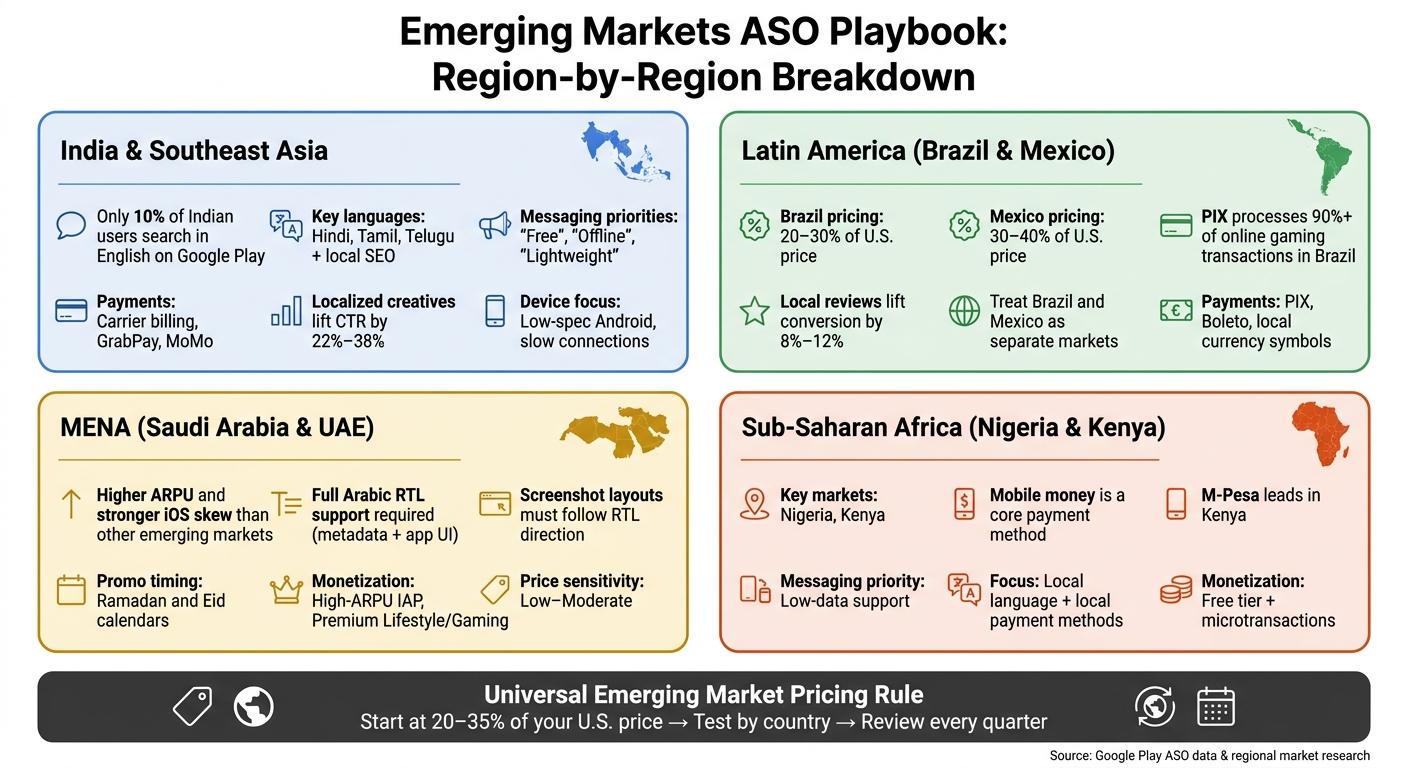
Use the base work above to shape each listing for each market. Search habits, phone limits, pricing, and payment methods can shift a lot from one region to the next.
Once the main listing is localized, move from broad rules to country-level execution.
India and Southeast Asia: Android-First Markets and Low-Data Messaging
In India, only 10% of users conduct English-language searches on Google Play. Most people search in Hindi, Tamil, Telugu, or other regional languages. That changes how you build your listing. Use local-language keywords, keep screenshots light, and make sure your metadata clearly signals "Free", "Offline," and "Lightweight".
Across Southeast Asia, especially Indonesia, Vietnam, Thailand, and the Philippines, internet access can vary a lot from place to place. So if your app works well on slower connections, say that clearly. Low-bandwidth support isn't a nice extra here. It's part of the pitch.
Payments matter too. Carrier billing and local wallets like GrabPay and MoMo are a big part of how people pay in these markets.
Latin America: Portuguese and Spanish Localization That Matches Local Search Behavior
Don’t treat Brazil and Mexico as one setup with two flags slapped on it. They behave like separate markets.
Brazilian Portuguese and Latin American Spanish use different search terms, and payment habits differ too. On top of that, local reviews and trust cues can lift conversion by 8% to 12%. A badge, a review in the local language, or pricing that feels familiar can help remove friction.
Pricing needs to match what people can spend. Set Brazil prices at 20–30% of the U.S. price and Mexico at 30–40%. In Brazil, local payment support matters in a big way: PIX processes over 90% of online gaming transactions in Brazil.
That means pricing and payments shouldn't be an afterthought. They should match local buying power from the start.
MENA and Sub-Saharan Africa: Cultural Fit, Arabic Support, and Local Payment Support
Saudi Arabia and the UAE tend to have higher average revenue per user and a stronger iOS skew than many other emerging markets. So the device mix may look different here than it does in Android-heavy regions.
Arabic support goes far beyond translation. Your metadata needs full right-to-left (RTL) treatment, including screenshot layout and navigation flows. And that RTL setup has to carry through into the app itself. If the store page reads right-to-left but the product experience doesn’t, users will feel the mismatch right away.
Visuals and timing matter as well. Use imagery that fits the region, and tie promos to local calendars like Ramadan and Eid.
In Sub-Saharan Africa, especially Nigeria and Kenya, two things stand out: low-data messaging and mobile money support. Both matter a lot. M-Pesa leads in Kenya, and mobile money is a core transaction method across the region.
Across these markets, focus on three basics:
- Local language
- Local payment methods
- Low-data messaging
Once the regional listing is in good shape, test pricing, reviews, and user acquisition channels at the country level.
Pricing, Reviews, and User Acquisition by Market
Once the listing is localized, conversion comes down to three things: price, trust, and traffic quality.
Test Local Pricing and Monetization Models by Country
Don’t lean on store auto-conversion from U.S. pricing. Set prices by region yourself so they line up with local buying power. That can improve purchase rates in markets like India, Indonesia, and Brazil.
A good starting point is 20–35% of your U.S. price for emerging markets, then fine-tune by country. In India, use .99 endings. In Brazil, keep sub-$5 items under R$20. For India and Southeast Asia, stay near the lower end of the range.
The model matters too, not just the sticker price. In Southeast Asia, battle passes and 14-day trials often beat one-time bundles. In South Asia, a free tier plus microtransactions in the $0.10–$1.00 range often works better than leading with a subscription.
| Market Cluster | Monetization Fit | Price Sensitivity | Conversion Risks |
|---|---|---|---|
| South Asia (India, Pakistan) | Free tier + Microtransactions ($0.10–$1) | Extreme | Lack of UPI/local payment support; high entry price |
| Southeast Asia (Indonesia, Vietnam) | Battle Pass, Carrier Billing, 14-day Trials | High | Low credit card penetration; internet infrastructure |
| Latin America (Brazil, Mexico) | PPP-adjusted Subscriptions, Pix/Boleto | Moderate–High | English-only listings; lack of local currency symbols |
| MENA (Saudi Arabia, UAE) | High-ARPU IAP, Premium Lifestyle/Gaming | Low–Moderate | Lack of RTL support; cultural misalignment |
Currency moves can chip away at your manual price setup, especially in Brazil and Indonesia. Check pricing every quarter.
Use Local Reviews and Ratings to Build Conversion
Track star ratings by country, not only at the global level.
Reply in the local language, and if you can, have a native speaker do it. Machine translation often misses the mark for Indic languages and other complex language groups, and users spot that fast. A bad reply tells people your team doesn’t understand the market.
Google Play review summaries now affect conversion, so deal with repeat complaints head-on. In India and Brazil, that means answering payment issues like UPI failures or missing Pix support in a direct way.
Review patterns aren’t just support noise. They’re signals that tell you what to fix next in each market.
Choose Acquisition Channels That Reinforce Organic ASO
Paid installs can help both ranking and organic discovery when the ad traffic lines up with the keyword people searched for.
"Listings that convert better tend to rank better, and listings that rank better convert more... It compounds." - Antonio Cappiello, Founder, PricePush
In Southeast Asia and Latin America, TikTok, Facebook, and Instagram Reels often drive lower customer acquisition costs than Google Search Ads. Estimated ROAS is about 2x to 5x in Southeast Asia and 2x to 4x in Latin America. In India, YouTube pre-roll is often a strong match, with ROAS around 1.5x to 2x.
One thing teams often miss: send paid traffic to a localized Custom Product Page (CPP) that matches the ad language. If the ad is in Hindi, the landing page should be a Hindi Custom Product Page, not an English listing.
Measure Results and Feed ASO Insights Back Into Your App
Track Country-Level KPIs and Run Store Experiments
Track performance by country. That means watching impressions, tap-through rate, conversion rate, installs, rankings, revenue per user, install-to-purchase conversion, and early uninstalls. These numbers can swing a lot from one market to the next, so the metrics you care about most should match the kind of market you're in.
In volume-driven markets like India, Brazil, and Indonesia, organic installs and store conversion rate tend to matter most. In value-driven markets, revenue per user and retention carry more weight.
| KPI | Volume-Driven (e.g., India, Brazil, Indonesia) | Value-Driven (e.g., Saudi Arabia, UAE) |
|---|---|---|
| Primary Focus | Organic Installs & Conversion Rate | Revenue Per User & Retention |
| Conversion Metric | Store Visit to Install (CVR) | Install-to-Purchase Rate |
| Growth Lever | Keyword Reach & Scale | Localized Creative & Pricing Tiers |
| Risk Metric | 48-Hour Uninstall Rate | Subscription Churn Rate |
Use this split to figure out where the issue sits: visibility, conversion, or retention.
When performance drops, look at the funnel step by step. High impressions with a low tap-through rate often means a metadata issue. Your icon, title, or subtitle may not be doing the job. High page views with a low conversion rate usually points to screenshots, descriptions, or local reviews. High installs paired with high early uninstalls often means the app experience doesn't match what the store listing promised.
For experiments, keep it simple: test one market at a time and compare matched cohorts, not total revenue.
Turn Market Signals Into App Updates and Launch Priorities
Once the data shows where the funnel breaks, push those findings into product decisions and launch planning.
Say keyword data shows heavy search demand for Hindi, Tamil, Arabic, or other local-script terms, but your metadata is still English-only. That's a plain gap. Fixing it can help you show up earlier for local searches. App Store search leans on the title, subtitle, and keyword field, while Google Play also indexes the full description, so update priorities can change by storefront.
User feedback can point to product work just as clearly. If people in Brazil report payment failures, move Pix support up the list. If ratings fall in one country, check for localization bugs or a mismatch between the app and local expectations.
If store visit-to-install rates are weak in one country, the fix is often localized screenshots that show the actual local UI.
Conclusion: A Simple Framework for Expanding ASO Across Emerging Markets
ASO in emerging markets works best when each part supports the others. Localization, pricing, and acquisition can't operate in silos. If one piece falls behind, the rest lose force too.
A simple way to approach it:
- Start with market research to understand device mix, language, and search behavior.
- Localize beyond plain translation with native-script metadata, local UI in screenshots, and visuals that fit the market.
- Set pricing by country using purchasing power parity as a starting point, then review it every quarter.
- Measure performance at the country level and feed those signals back into product work and store listing updates.
The aim isn't just to track ASO numbers. It's to use those numbers to shape the next local release.
If you need help turning ASO data into app updates, Appeneure can help with UI/UX, localization, and new-market builds.
FAQs
How do I choose which emerging market to localize first?
Start by checking your data in App Store Connect or Google Play Console. Look for regions that are already bringing in organic installs even though you haven’t localized your metadata yet. That’s often the first sign that a market is worth a closer look.
From there, focus on markets with:
- High smartphone use
- Reliable internet access
- A strong fit between local user behavior and your app category
Next, look at demand in your category, how split up the competition is, and whether the market is ready to spend. That includes local payment support and purchasing power parity, not just exchange-rate-based pricing.
In plain English: a country may look cheap or expensive on paper, but exchange rates don’t tell you what people can and will pay inside an app. If you skip that part, pricing can miss the mark fast.
What should I localize first if my budget is limited?
Start with the places that can move the needle most. Look at the countries where people are already finding your app even though you haven’t localized it yet. Those markets should come first.
Next, localize your app title and subtitle with high-quality human translation. For store descriptions, machine translation is fine as a starting point. Then add localized screenshots and adjust pricing by region based on purchasing power parity.
How long should I test pricing and creatives by country?
There’s no fixed timeline. ASO is an ongoing, iterative process, so review rankings, keyword performance, and conversion rates each month to decide when to make changes.
Start with small tests in one or two regions. Then check user feedback and conversion data before you expand. If conversion rates stay below the U.S. benchmark, audit that market right away.
More from the studio