All blogs
AI App Development
Cost of AI Voice Synthesis in Mobile App Development
Breaks down upfront and monthly costs of adding AI voice to mobile apps, with build paths, budgets, and cost-saving tips.
9 min read

Cost of AI Voice Synthesis in Mobile App Development
AI voice synthesis in mobile apps can cost anywhere from $5,000 to $500,000+, and the biggest bill often is not the voice itself. If I had to sum it up fast, I’d say this: your cost depends on scope, latency, offline use, language count, and whether you use a prebuilt API, a custom cloud setup, or a fully custom system.
If you’re planning this feature, here’s the short version:
- Small MVPs often land around $15,000–$40,000
- Basic app builds usually fall in the $30,000–$60,000 range
- Mid-level apps often cost $60,000–$120,000
- Advanced voice apps can hit $150,000–$500,000+
- Yearly maintenance often adds 30%–50% of the first build cost
- Monthly hosting can range from $15 to $2,500
- Custom cloud setups often add $1,000–$10,000+ per month
- Fully custom voice systems can run $30,000+ per month
What changes the price most?
- More human-sounding speech
- Low-latency replies
- Offline playback
- Multi-language support
- Caching, storage, and backend work
- Security setup like ephemeral tokens
- Testing across iOS, Android, devices, and OS versions
The main point: a low launch price can turn into a high monthly bill if usage climbs or the system is built the wrong way.
A simple way to think about it:
| Build path | Upfront cost | Monthly cost | Best fit |
|---|---|---|---|
| Prebuilt API | $5,000–$30,000 | Usage-based | Fast MVPs |
| Custom cloud setup | $60,000–$150,000 | $1,000–$10,000+ | Apps that need more control |
| Fully custom system | $150,000–$500,000+ | $30,000+ | Voice-led products |
I’d plan the budget in two parts: build cost now and run cost later. That means looking at discovery, design, development, testing, AI fees, hosting, support, and maintenance before you ship the first version.
How Much Does an AI Voice Assistant Really Cost? Google AI Studio + Cloud Pricing Explained
sbb-itb-622dc24
What Makes AI Voice Synthesis Expensive
AI voice synthesis gets pricier as it starts to sound more human, respond faster, and fit each user more closely. Those product choices affect both the cost to build the feature and the money it takes to run it over time.
Product Requirements That Drive Up Cost
A basic text-to-speech feature that simply reads content aloud is usually fairly affordable. But the moment you add more natural speech, low latency, back-and-forth responses, and personalization, the work gets much harder. And the budget climbs with it.
Offline support adds cost because the app needs local assets or on-device processing. That means more engineering work and more storage. Multilingual support pushes costs up too. Every new language adds model work, testing, and tuning to keep the output consistent.
Put simply, each new requirement adds more engineering, infrastructure, and testing.
Technical Constraints That Affect Budget
Some of the cost comes from choices made before a single line of product code is written. On mobile, iOS and Android often need different audio handling. So if you want a voice feature to feel the same on both platforms, you usually need platform-specific engineering, not just shared logic.
API rate limits and caching also shape the budget. If every line of text is sent to a cloud speech API in real time, costs grow with usage. And if repeated phrases aren't cached, those API bills can pile up fast. Audio storage matters too. Saving pre-rendered audio for common responses can cut latency, but it also means more planning around storage and delivery.
Prelaunch testing takes time as well. Audio behavior can shift from one device to another and from one OS version to the next, so teams need room in the budget for that work.
Security is another cost driver. Embedding static API keys in a mobile app is risky. Using ephemeral tokens instead of static keys means adding backend infrastructure, but it helps lower the chance of expensive breaches.
In practice, scope, latency, and offline support usually decide whether the project stays light or turns into a custom setup. Those needs shape the build path that makes sense next.
Cost Breakdown by Development Approach
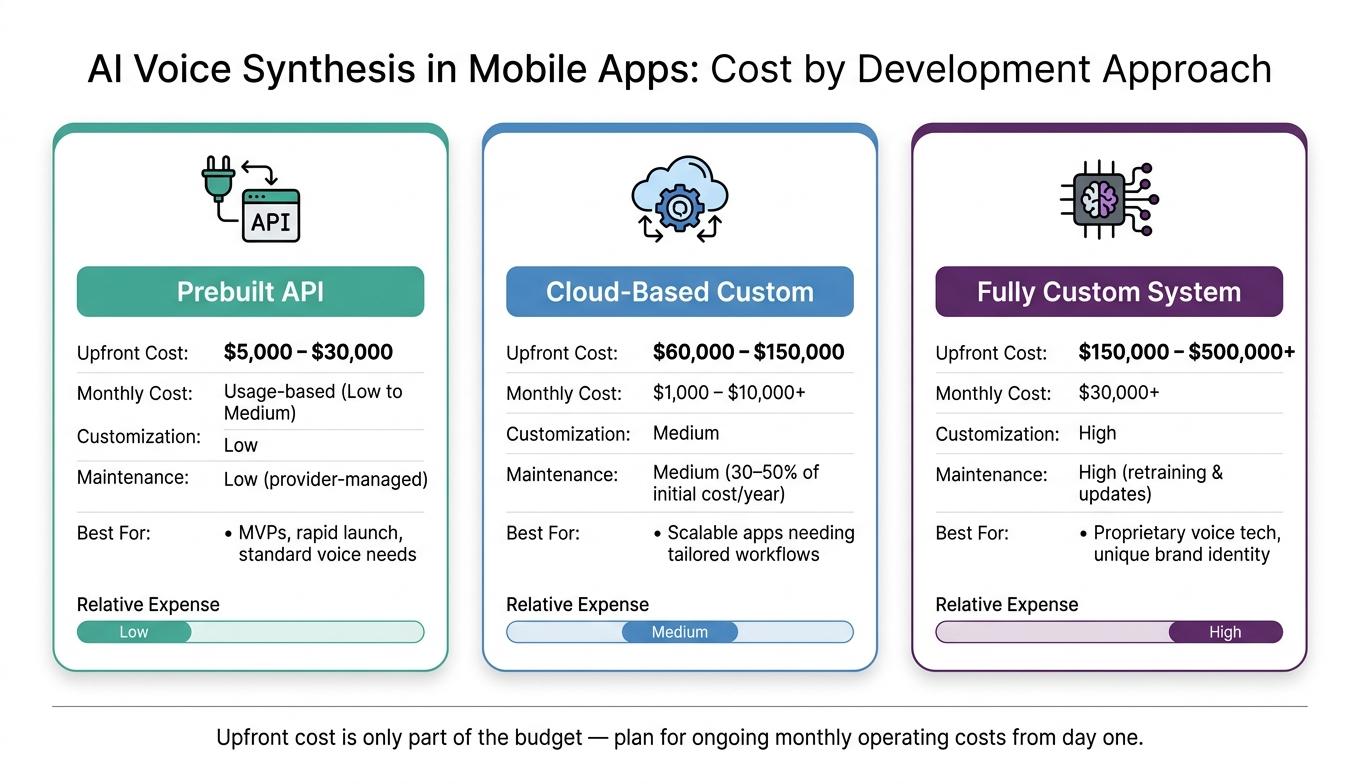
Three build paths shape both launch cost and monthly spend. The big differences come down to control, speed, and operating cost. In most cases, the right fit depends on your scope, latency targets, and whether the app needs to work offline.
Prebuilt API Integration
This is the fastest way to get a voice feature live. You connect your app to a managed service, and the provider handles the infrastructure behind the scenes. Upfront development usually falls between $5,000 and $30,000, based on how deeply the feature is woven into the product. Monthly costs are usage-based, so spending goes up as request volume grows.
The tradeoff is less control. This path makes sense when you need to launch fast and standard speech output does the job.
Cloud-Based Custom Architecture
Once a prebuilt API starts to feel limiting, many teams move to a custom backend that still runs on managed cloud infrastructure. This setup adds custom logic, caching, and tailored workflows on top of the speech models underneath. Upfront costs usually range from $60,000 to $150,000, and monthly infrastructure spend often lands between $1,000 and $10,000+, depending on traffic and feature depth. Maintenance is also higher because the team now owns the backend and its integrations.
This is the middle-ground choice for apps that need to scale and need more control, without taking on full model ownership.
Fully Custom Voice Synthesis System
Building a proprietary voice system means owning the model, the training pipeline, and the infrastructure. That gives you full control over how the voice system sounds and behaves. It also comes with a much bigger price tag: upfront costs start at $150,000 and can go beyond $500,000, while monthly GPU and training costs often run $30,000+.
This path only makes sense when voice is a core product asset. It also brings heavy maintenance work, since retraining and updates aren't one-and-done tasks.
| Approach | Best Use Case | Estimated Upfront Cost | Ongoing Monthly Cost | Customization | Maintenance Effort |
|---|---|---|---|---|---|
| Prebuilt API | MVPs, rapid launch, standard voice needs | $5,000 – $30,000 | Low to medium (usage-based) | Low | Low (provider-managed) |
| Cloud-Based Custom | Scalable apps needing tailored workflows | $60,000 – $150,000 | Medium ($1,000 – $10,000+) | Medium | Medium (30–50% of initial) |
| Fully Custom | Proprietary voice tech, unique brand identity | $150,000 – $500,000+ | High ($30,000+) | High | High (retraining & updates) |
Next, those costs split into one-time build work and recurring operating expenses.
Where the Budget Goes in a Mobile App Project
After you pick a build path, the next step is simple: split the budget into launch costs and monthly operating costs.
That split matters. Prebuilt APIs usually keep upfront spending lower. A custom backend moves more of the budget into development and hosting. So the total cost isn't just about what you build. It's also about where the money goes.
Here's how the line items usually break down.
One-Time Build Costs
Most projects start with discovery, which typically runs $4,500–$8,000. This is the planning stage where the team maps out goals, features, and technical needs.
From there, UI/UX design usually lands in the $15,000–$30,000 range. Then comes development, which is almost always the biggest cost line at $35,000–$75,000.
Testing and launch support add another $10,000–$22,000. That covers the last-mile work that helps an app go live without avoidable issues.
Recurring Operating Costs
Once the app ships, the budget shifts from building to running. At that point, most monthly spending falls into three buckets:
- AI usage fees
- Hosting
- Maintenance
Hosting costs usually climb with traffic. A small app with up to 1,000 daily active users might pay $15–$50 per month. A much larger app serving 101,000 to 1,000,000 daily active users can run $500–$2,500 per month.
Ongoing engineering support typically runs $6,560–$8,640 per month, and customer support adds $2,400–$3,040 per month.
Budget Ranges by App Complexity
The size of the app changes both the timeline and the price tag. A simple app can be built in a few months. A more advanced product with custom models and scaling needs can take close to a year, or longer.
| Complexity Tier | Common Feature Set | Typical Timeline | Expected Cost Range |
|---|---|---|---|
| Basic | Simple voice playback, basic UI | 2–4 months | $30,000 – $60,000 |
| Mid-Level | Personalized voice, multi-language support, custom backend | 4–6 months | $60,000 – $120,000 |
| Advanced | Custom deep learning models, emotion-aware voice control, real-time scaling | 9–12+ months | $150,000 – $500,000+ |
These tiers make one thing clear: scope is what pushes cost up. Add custom systems, deeper AI features, or heavy traffic needs, and the budget moves fast.
How to Cut AI Voice Synthesis Costs Without Losing Quality
Once you’ve picked your build path, the biggest cost cuts usually come from scope, system design, and how often people use the feature.
Start With a Smaller Feature Set
Start with the voice features that matter most, then add more later.
That does two things. First, it trims launch costs. Second, it helps your team learn what users care about before you spend money on extras they may not even use.
Build for Efficiency From Day One
Keep the model logic on the backend, and send the app only the text and user inputs it needs.
This setup keeps the app lighter and easier to manage. It can also lower monthly costs, since you’re not pushing more data or logic to the front end than needed.
Use ephemeral tokens instead of raw API keys. That helps reduce build work and can trim recurring operating costs at the same time.
Work With a Team That Can Scope Accurately
A team that can scope the work well will save you money in places that are easy to miss.
Clear scoping and phased delivery help cut rework, keep timelines under control, and stop voice features from drifting past budget. Those choices shape the total cost, not just what you spend to launch.
Conclusion: Plan for Total Cost, Not Just Launch Cost
AI voice synthesis costs come down to scope, system design, and day-to-day operations. So the first build is only one piece of the budget.
That’s why launch price alone is a bad signal. A cheap launch can turn costly fast once you add maintenance, hosting, support, and usage fees.
For most teams, the safest move is a phased rollout. Start with a prebuilt API integration. Then shift to a cloud-based custom setup as usage grows. If voice becomes central to the product, move from a light launch to a custom build only when demand makes the math work.
The best budgets start with total cost of ownership. Plan for the build, hosting, usage, and maintenance from day one - not just the first release.
FAQs
Which cost model fits my app best?
The right cost model comes down to your app’s scale, complexity, and growth plan.
For most mobile apps, pre-trained voice APIs are the lower-cost option. They usually run about $0.006 to $0.12 per request or around $0.02 per minute. If you need more custom, deep learning-based features, expect to spend more.
To keep costs in check, Appeneure recommends starting with an MVP and then scaling as demand grows. A hybrid approach can also help balance performance and cost.
When should I move beyond a prebuilt API?
Move beyond a prebuilt API when your app needs more control, better speed, or features that off-the-shelf tools just can’t handle. Prebuilt APIs are a solid fit for MVPs because they save time and keep costs down.
It usually makes sense to switch when you need lower latency, specialized accent recognition, custom vocabulary, or when per-request API fees start costing more than running your own setup or a hybrid infrastructure.
How can I keep monthly voice costs under control?
Use rate limiting, usage quotas, and detailed metadata tags to track costs by user, feature, and model. That makes it easier to spot spend early, avoid surprise spikes, and plan ahead with more confidence.
A hybrid setup that mixes on-device processing with cloud resources can also help balance cost and performance. And when you match the model to the job - instead of sending every request to a heavier option - you can cut costs without giving up speed where it matters.
More from the studio