All blogs
Mobile App Development
ASO Ranking Factors in 2026: iOS vs. Android Keywords
Compare iOS and Android ASO keyword strategies, testing guidance, and measurement best practices for clear ranking insights.
7 min read

ASO Ranking Factors in 2026: iOS vs. Android Keywords
I use separate keyword plans for iOS and Android - not one ranking formula. On iOS, I map terms to the app name, subtitle, and 100-byte keyword field. On Google Play, I focus on the title, short description, and full description.
For both stores, I match wording to U.S. search intent, check that claims match the app, and track search position separately from installs and retention. <u>A conversion lift does not prove a ranking lift.</u>
Quick Comparison
| What I compare | Apple App Store | Google Play |
|---|---|---|
| Keyword placement | App name, subtitle, keyword field, primary category | Title, short description, full description |
| Listing variants | Up to 70 custom product pages | Up to 50 custom store listings |
| Ranking inputs | Text relevance, downloads, ratings, reviews | Relevance, engagement, ratings, reviews, downloads, quality |
| Test guidance | Apple identifies 90% or higher confidence as reliable for conversion tests | Google recommends running listing experiments for at least one week |
My approach: localize each listing, log a baseline, isolate changes where possible, and require human approval. Neither store publishes full ranking weights, so I keep documented rules, observed results, and untested theories separate.
iOS Keyword Optimization: Name, Subtitle and Keywords | ASO Lab 02
sbb-itb-622dc24
1. Apple App Store (iOS)
On iOS, keyword ranking starts with indexed metadata, followed by behavior signals.
Keyword metadata
Apple limits the keyword field to 100 bytes. Terms must be longer than two characters and separated by commas, with no spaces after them. Use this space for distinct, high-intent terms. Skip duplicates, category names, “app,” competitor names, and trademarks you don’t have permission to use. Your app name and company name are already searchable. Pick specific terms that describe what your app does - not just what’s popular.
Localization and listing variants
Match keywords to U.S. search intent rather than translating them word for word. Apple supports up to 70 custom product pages per app, each with its own screenshots, previews, promotional text, and localizations.
Search queries can send users to a matching custom page instead of the default page. Give each page a distinct keyword set that matches the user’s intent. This changes landing-page routing, not rank.
Ranking evidence
Apple publishes ranking inputs, but not their weights. Don’t assume one input takes priority over another. Treat claims about keyword weight, repetition, or rating-driven rank changes as hypotheses unless first-party evidence proves them.
Apple also doesn’t publish ranking windows. Keep its documented inputs separate from ranking effects teams observe after metadata changes.
Once you’ve selected keywords, measure visibility and conversion separately.
Performance measurement
Track search visibility, product-page views, downloads, retention, and revenue as separate metrics. Apple impressions cover more than search, so total impressions don’t measure keyword rank.
Product Page Optimization tests up to three alternative product pages against the original and reports conversion improvement and confidence. Apple identifies 90% or higher confidence as indicating reliable results.
Before publishing a metadata test, record your baseline, change log, observation window, and success criteria. Don’t change pricing, visual assets, or acquisition efforts at the same time. Require human approval before reporting that a change caused a result.
2. Google Play (Android)
Google Play relies more on broad relevance and quality signals than on field-specific keyword slots.
Keyword metadata
Focus on the app title, short description, and full description for keyword relevance. Put the core use case first in the title and short description. Use the full description to support your keywords - not stuff them in.
Google also considers category and quality signals, but it doesn’t publish field weights or an ideal keyword density. Repeating a term isn’t a documented shortcut to better rankings.
Localization and listing variants
Google supports up to 50 custom store listings, with targeting by country, user state, and search keyword. Custom listings change exposure, not rank.
Localize copy and assets for each market. Then measure acquisition and retention separately from search rank.
Ranking evidence
Google names ratings, reviews, downloads, and quality signals as search factors. Editorial placement and ads affect discovery, not keyword rank. Search puts more weight on query relevance, while Top Charts lean more on popularity. So when rankings shift after a metadata edit, check your test logs rather than assume the edit caused it.
Results also vary by device, location, mobile carrier, and supported features. Higher rankings after a description rewrite show a correlation - not proof that the wording caused the change. Downloads, feedback, or search context may explain the movement.
Performance measurement
Run Google Play listing experiments for at least one week to cover weekday and weekend traffic. Localized experiments support up to five languages.
Record the variant, target metric, sample size, duration, and confidence interval. Track query visibility separately from install clicks, opens, and retention. A conversion lift is evidence for the listing test - not proof that the change improved organic rank. Use those logs to decide which changes need human review.
A Human-Supervised Keyword Workflow
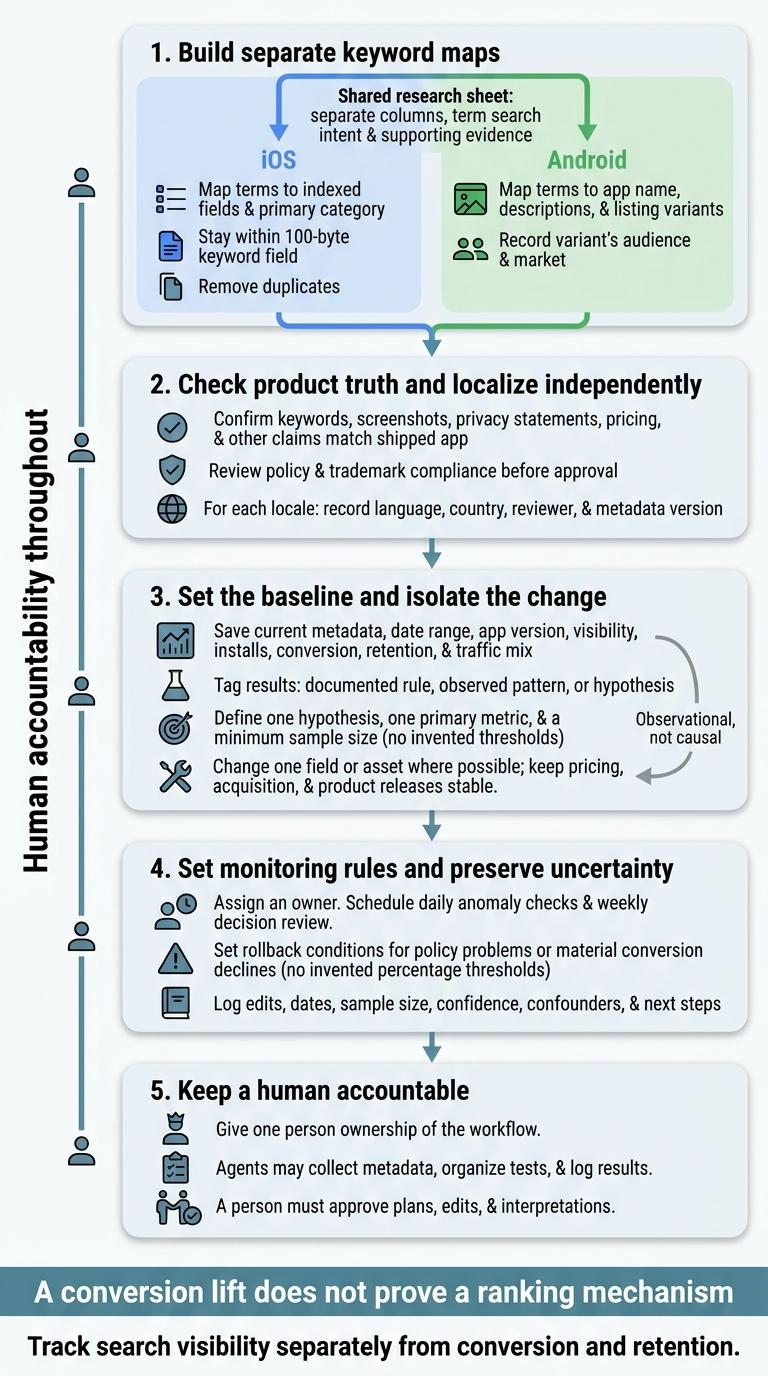
Use the platform differences above to run one human-reviewed workflow for both stores.
Build separate keyword maps. Keep iOS and Android columns in one research sheet. Record search intent and supporting evidence for each term. For iOS, map terms to indexed fields and the primary category, stay within the 100-byte keyword field, and remove duplicates. For Android, map terms to the app name, descriptions, and applicable listing variants. Record each variant’s audience and market.
Check product truth and localize independently. Make sure keywords, screenshots, privacy statements, pricing, and other claims match the shipped app. Review policy and trademark compliance before approval. Record the language, country, reviewer, and metadata version for each locale.
Set the baseline and isolate the change. Save the current metadata, date range, app version, visibility, installs, conversion, retention, and traffic mix. Tag each result as a documented rule, observed pattern, or hypothesis. Before launch, define one hypothesis, one primary metric, and a minimum sample size. Change one field or asset where possible, while keeping pricing, acquisition, and product releases stable. Label uncontrolled before-and-after comparisons as observational, not causal.
Set monitoring rules and preserve uncertainty. Assign an owner, schedule daily anomaly checks and a weekly decision review, and set rollback conditions for policy problems or material conversion declines. Log edits, dates, sample size, confidence, confounders, and next steps. A conversion lift does not prove a ranking mechanism.
Keep a human accountable. Give one person ownership of the workflow. Agents can collect metadata, organize tests, and log results, but a person must approve plans, edits, and interpretations.
Conclusion: Follow Documented Rules and Test Unknown Effects
Different field structures call for different keyword plans - not different assumptions about ranking certainty. Apple uses an app name, subtitle, and 100-byte keyword field. Google Play uses a title, short description, and full description. Neither store publishes a universal ranking formula.
These differences affect how you interpret keyword relevance. Keep four concepts separate: relevance means a term describes the app’s purpose; indexing means it’s eligible for search matching; listing targeting defines the audience or intent a page addresses; and ranking position is the placement you observe in a specific search context.
When reviewing test results, treat published limits and policies as facts, repeated results as observations, and ranking theories as hypotheses until testing supports them. Assess changes by traffic quality and user outcomes - not rank alone. Keep human review between what you observe and any claim about what caused it.
FAQs
How do I choose keywords for a new app?
Start with your app’s features and what your audience wants, not search volume alone. Find keywords in user reviews, competitor research, and ASO tools. Check which keywords competitors rank for on both iOS and Android.
Choose terms that fit your key metadata fields. Put your top keywords in the iOS title, then use complementary terms in the subtitle and keyword field. Every 3–4 weeks, review search rankings, click-through rate, conversion, and download velocity.
How long should I track rankings after a keyword change?
Review your rankings every 3 to 4 weeks to collect enough data to spot meaningful trends and changes in performance. Track search volume, ranking position, click-through rate, conversion rate, and download velocity to see which keywords deliver results - and which may need replacing. These check-ins help you adjust your approach as user behavior and competitor activity change.
How can I tell whether a keyword change caused a ranking lift?
Don’t rely on correlation alone. After updating keywords in your metadata, check performance every 3–4 weeks. Track ranking position, click-through rate (CTR), conversion rate, and download velocity - the downloads driven by that keyword.
If rankings improve but the other metrics don’t, engagement or market shifts may explain the increase rather than the keyword update. These metrics help you assess the change, but they don’t prove causation.
More from the studio