All blogs
AI App Development
AI's Role in Reducing Licensing Costs
How AI detects unused licenses, forecasts needs, automates compliance, and cuts SaaS and software licensing costs by up to 40%.
12 min read

AI's Role in Reducing Licensing Costs
Managing software licensing costs is a growing challenge for businesses, especially those building AI-powered applications. Rising expenses, unpredictable pricing models, and unused licenses are eating into budgets. Here's the good news: AI can help.
Key takeaways:
- Unused licenses waste money: 55% of enterprise software licenses go unused, costing companies millions annually.
- AI identifies inefficiencies: AI tools analyze usage patterns to flag underused licenses, match allocations to actual needs, and detect "zombie accounts."
- Savings are real: Companies like Siemens and Unilever have saved millions annually by using AI for smarter license management.
- Predictive analytics prevent overspending: AI forecasts future needs, avoiding over-provisioning and aligning costs with actual demand.
- Automation reduces admin work: AI simplifies compliance, reconciliation, and renewals, cutting manual effort by up to 80%.
AI-driven solutions not only reduce costs but also streamline operations, making them indispensable for businesses navigating today's complex licensing landscape.
I Replaced $500/Month in AI Subscriptions with This $10 Secret - AI Companies HATE This
sbb-itb-622dc24
How AI Optimizes Licensing Costs
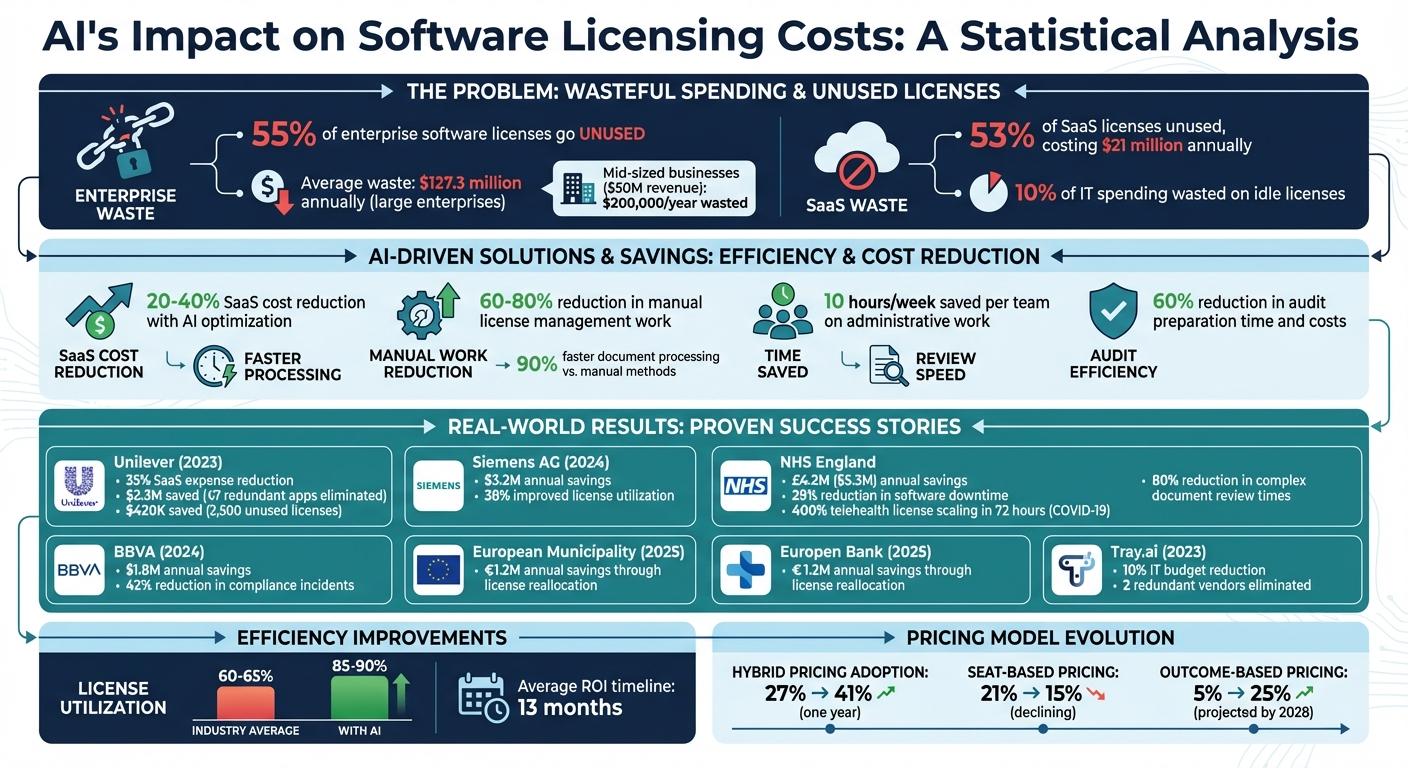
AI tools take the guesswork out of managing software licenses by analyzing real-time usage patterns. Instead of relying on manual spreadsheets, they provide precise insights into which licenses are active, who is using them, and whether they’re worth the investment. The numbers are staggering: 55% of enterprise software licenses go unused, costing large companies an average of $127.3 million annually. For mid-sized businesses with $50 million in revenue, the waste can top $200,000 per year.
Finding Underutilized Licenses
AI dives deep into usage data, tracking everything from logins to specific feature usage. This allows it to flag cases where employees with premium licenses are only using basic tools. For example, if someone has a Microsoft 365 E5 license but only uses features available in the E3 tier, AI can highlight the mismatch.
Take the example of a European municipality in 2025: They used the LicenseQ Hub AI platform before renewing their Microsoft subscription. The platform categorized their workforce into four groups - Knowledge Workers, Compliance-heavy, Frontline, and Shared Devices. This analysis revealed hundreds of over-licensed employees. By reallocating licenses more effectively, the municipality saved €1.2 million annually and set up an automated system to assign licenses to new hires.
"LicenseQ didn't just help us save money at renewal - they gave us a way to keep control over our Microsoft environment, continuously".
AI also hunts down "zombie accounts" - licenses tied to former employees or users who haven’t logged in for 90 days. Automated workflows can send verification messages through tools like Slack or Teams to confirm if access is still needed. If not, the system deactivates the license automatically, ensuring no wasted spend.
But it doesn’t stop at identifying unused licenses. AI actively helps companies avoid over-provisioning by matching license allocations to actual demand.
Preventing Over-Provisioning
AI goes beyond static historical data, using real-time usage patterns and growth trends to predict future needs. This prevents the common mistake of buying licenses in bulk "just in case", only to let them sit idle.
For instance, Tray.ai adopted this approach in 2023 to manage its 152 active vendors. Their AI-driven workflow flagged underused tools and sent tailored messages to employees, leading to a 10% reduction in their overall IT budget. They also eliminated two redundant vendors in the process. By ensuring licenses are allocated precisely when and where they’re needed, AI helps organizations cut costs while staying efficient.
AI-Driven Predictive Analytics for Long-Term Cost Control
AI isn't just about managing current licensing needs - it’s also a powerful tool for planning ahead. Predictive analytics takes cost control to the next level by forecasting future licensing requirements. By analyzing historical data, machine learning models can detect patterns like seasonal trends, growth cycles, and organizational shifts. This helps businesses avoid unexpected demand spikes or paying for licenses that go unused.
Forecasting Future Licensing Requirements
Did you know that around 53% of SaaS licenses go unused, costing companies an average of $21 million annually? Predictive analytics tackles this issue by processing massive datasets - think over 2 million logins and 500 GB of logs - to uncover trends that might otherwise go unnoticed. For example, decision-tree models trained on login data and user metadata can predict whether an employee will need a specific license tier in the next quarter.
Take Siemens AG as an example. In 2024, they rolled out "LicenseIQ", a custom AI platform designed to analyze usage patterns in manufacturing. By predicting license needs based on production schedules, Siemens improved license utilization for engineering software by 38% and saved $3.2 million annually through smarter renewals. Similarly, Unilever used an AI-powered SaaS management tool in 2023 to oversee more than 200 applications. By analyzing Microsoft Office usage, they discovered that only 11,000 of their 15,000 licenses were active. They adjusted to 12,500 licenses, saving $420,000.
AI also supports "what-if" scenario modeling. For instance, you can simulate the financial impact of shifting 30% of users from premium to basic license tiers before making a decision. These insights not only cut unnecessary expenses but also help align spending with your business’s evolving goals.
Aligning Licensing Strategies with Business Goals
AI isn’t just about saving money - it’s about aligning licensing strategies with broader business objectives. BBVA, for example, implemented an AI-driven system in 2024 to manage regulatory and operational SaaS needs. This system used predictive analytics to anticipate regulatory impacts and optimize renewals, saving $1.8 million annually and cutting compliance-related incidents by 42%.
Real-time monitoring is another game-changer. AI can detect "license drift", where role changes or new hires lead to mismatched licenses that drive up costs. NHS England’s "HealthLicense AI" system is a great example. It automatically provisioned licenses during health emergencies, optimized existing allocations, saved £4.2 million annually, and reduced software downtime by 29%.
Boston Consulting Group highlights that AI’s real value comes from transforming business processes.
The shift in pricing models also reflects this transformation. Hybrid pricing models, which combine elements like usage-based and tiered pricing, have jumped from 27% to 41% adoption, while traditional seat-based pricing has dropped from 21% to 15%. Organizations adopting predictive analytics typically see SaaS cost reductions of 20–40%, with most achieving results within about 13 months.
Automating Compliance and Reducing Administrative Work
Handling compliance manually is not only time-consuming but also prone to errors. Without automation, compliance officers often find themselves dedicating a staggering 60% of their time to tasks like manual data entry and status tracking. This heavy workload pulls focus away from more strategic initiatives. By pairing AI-driven cost forecasting with automated compliance, organizations can ensure licensing accuracy while reducing administrative burdens.
Monitoring License Compliance
AI-powered systems integrate seamlessly with databases and regulatory feeds to keep a constant eye on license statuses. When a license approaches its renewal period, the system automatically initiates workflows to streamline the process. On top of that, technologies like Natural Language Processing (NLP) and Optical Character Recognition (OCR) extract critical details from certificates, contracts, and forms, checking for completeness and flagging any discrepancies.
The benefits are undeniable. Automating these processes can cut audit preparation time and costs by up to 60%, turning what used to be frantic manual efforts into simple, one-click exports. In pilot programs focused on complex document reviews, AI has shown its ability to reduce processing times by as much as 80%, shrinking timelines from days to mere hours. Every step in this automated process is timestamped, creating a comprehensive, audit-ready trail.
Real-world examples highlight the effectiveness of these solutions. In 2025, the Commonwealth of Pennsylvania revamped its licensing platform with AI-driven workflows. This upgrade slashed permit wait times from eight weeks to just two days, a key factor in attracting Amazon’s $20 billion investment for a new cloud- and AI-enabled campus. Similarly, the City of Hamilton in Ontario introduced AI-powered prescreening for permit reviews, cutting review times by 60%.
These automation tools not only simplify compliance but also ensure licenses are reconciled efficiently, providing end-to-end management solutions.
Simplifying Reconciliation Processes
Matching software purchases with actual usage is another area where AI shines. It automates the process of mapping entitlements, delivering an accurate Effective License Position (ELP) in real time and eliminating the need for tedious spreadsheet reconciliations. AI tools can also compare older and newer versions of vendor agreements, identifying changes in liability, data handling, and regulatory requirements.
The results speak for themselves. Organizations using AI for agreement analysis report document processing speeds that are 90% faster than manual methods. On average, teams save about 10 hours of administrative work each week thanks to AI-driven compliance tools. Additionally, AI can detect overlapping licenses, duplicate subscriptions, and unauthorized "shadow IT" SaaS usage - hidden risks that could otherwise go unnoticed. By integrating AI tools with HR systems, training platforms, and procurement databases, businesses can establish a unified source of truth for managing licenses across various jurisdictions. This streamlined approach not only simplifies reconciliation but also ensures every licensing expense is accounted for and optimized.
Integrating AI for Cost-Efficient App Development
Using AI Tools in Development Workflows
Development teams constantly juggle the need to control costs while maintaining speed and quality. One way to tackle this challenge is by embedding AI-driven license management into development workflows. These AI agents seamlessly integrate with existing systems, analyzing usage patterns to provide real-time recommendations on license allocation. Instead of merely tracking license assignments, these tools actively identify areas where resources are being wasted.
Inefficiencies in license usage can significantly impact budgets - research shows that up to 10% of IT spending is wasted on idle licenses. AI-driven tools address this by flagging underutilized software and automating de-provisioning processes. For example, they can send Slack notifications to streamline actions, cutting up to 40% of SaaS expenses and preventing unnecessary license waste.
Additionally, AI tools are helping development teams shift from traditional seat-based pricing to consumption-based models, ensuring costs align more closely with actual usage. Automated workflows can verify user needs and handle license de-provisioning with just a single click, simplifying resource management.
A great example of this in action is GitHub's use of its Copilot coding agent in 2024. With minimal human guidance, Copilot resolved 70% of accessibility issues, allowing the team to meet their goals without disrupting their primary feature roadmap.
"AI agents aren't replacing accessibility expertise - they're increasing your ability to attend to this critical work without deprioritizing your feature roadmap".
By integrating AI into workflows, teams not only cut costs but also open doors to practical applications, as seen in forward-thinking companies.
Case Study: Appeneure's AI-Powered Development Approach
Appeneure provides a clear example of how targeted automation can address licensing challenges while enhancing efficiency. Specializing in AI-powered and conversational AI agent development, Appeneure has delivered projects for over 100 clients across industries like dating, fitness, health tech, e-commerce, and AI-driven solutions.
Appeneure uses AI agents to handle routine, standardized tasks - such as accessibility fixes, documentation updates, and minor improvements - that would otherwise demand significant developer time and additional tool licenses. This approach directly combats the licensing cost issues mentioned earlier. By assigning well-defined tasks to AI tools, Appeneure ensures its teams stay focused on their roadmaps while reducing the need for extra software subscriptions. This aligns with the broader trend of agentic automation, where AI agents make real-time decisions about license allocation and even automate renewals.
Appeneure’s expertise also helps its clients prepare for emerging pricing models like outcome-based pricing. Although only 5% of companies currently use this model, adoption is projected to grow to 25% by 2028. By building scalable, AI-enhanced applications, Appeneure enables clients to navigate these evolving structures while managing computational costs. For context, gross margins for traditional SaaS companies often exceed 80%, but AI-enhanced businesses typically see margins closer to 50%-55% due to higher computational demands.
This approach not only controls costs but also positions Appeneure’s clients for long-term success in a rapidly changing landscape.
Measured Results: Cost Savings Through AI Optimization
Quantifying Cost Savings
AI's ability to deliver measurable cost reductions in license management is undeniable. By automating and optimizing processes, organizations have unlocked substantial savings. The numbers speak for themselves.
Take Unilever, for example. In 2023, they deployed an AI-powered SaaS management platform, Zylo, across their global operations - spanning 190 countries and supporting 190,000 employees. In just one year, this initiative slashed their SaaS expenses by 35%. Specifically, they eliminated 47 redundant applications, saving $2.3 million annually, and addressed 2,500 unused Office licenses, cutting an additional $420,000 annually.
Siemens AG offers another compelling case. Their custom-built "LicenseIQ" platform managed $45 million in annual SaaS spending across 125 countries. By optimizing renewals and using predictive analytics, Siemens achieved $3.2 million in annual savings. Similarly, NHS England's "HealthLicense AI" system managed software for hundreds of hospitals, saving $5.3 million annually while reducing downtime by 29%.
These examples reflect a broader trend. On average, companies waste 20–30% of their SaaS budgets on unused licenses and redundant software. However, AI-driven solutions can cut SaaS costs by 20–40%. Organizations that utilize AI effectively see license utilization rates soar to 85–90%, compared to the industry norm of 60–65%. Clearly, AI isn't just a tool - it's a transformative force in cost management.
Scalable Solutions for Dynamic Teams
AI's benefits extend beyond cost savings - it offers unparalleled flexibility for teams with evolving needs. These systems adjust in real time, ensuring resources match demand without waste.
For instance, during the COVID-19 pandemic in 2020, NHS England's HealthLicense AI system scaled telehealth licenses by an astounding 400% within just 72 hours. This rapid response showcased AI's ability to adapt instantly to unprecedented demand surges.
AI also continuously monitors usage patterns, reallocating resources as needed to prevent over-provisioning. This adaptability is particularly valuable for app development teams, where workloads can vary dramatically across project cycles. Additionally, AI reduces the manual workload of license management by 60–80%, allowing teams to focus on innovation and development instead of administrative tasks.
These dynamic capabilities highlight how AI not only saves money but also empowers teams to work smarter, faster, and more efficiently. By combining cost efficiency with real-time adaptability, AI-driven solutions are reshaping the way organizations manage their resources.
Conclusion: AI as a Solution for Licensing Cost Management
AI has the power to transform licensing from a financial drain into a strategic advantage. Many organizations lose significant resources on unused licenses and redundant software, but AI-driven tools can slash these costs while streamlining operations and boosting efficiency. Shifting from outdated, manual processes to automated, proactive systems isn't just about cutting expenses - it’s about rethinking how businesses allocate and manage their resources.
The industry is already adapting. Traditional seat-based pricing models are giving way to more dynamic approaches as AI agents take on tasks previously handled by humans. Hybrid pricing models, for instance, have grown from 27% to 41% in just a year, signaling a major shift. Businesses adopting usage-based licensing and intelligent right-sizing strategies are seeing license utilization rates soar to 85–90%, a significant improvement over the typical 60–65%.
Real-world examples highlight the dramatic savings and efficiencies AI-driven licensing optimization can deliver. These cases underscore a new approach to software resource management.
For mobile and web application developers, AI integration goes beyond cost savings - it opens doors to smarter, more resource-efficient solutions. Appeneure, a leader in AI-powered app development, specializes in crafting intelligent solutions that optimize resource use from the ground up. With a track record of delivering apps across industries like dating, fitness, health tech, e-commerce, and AI-powered platforms for over 100 clients, Appeneure embeds cost-efficient AI strategies directly into application design.
The message is clear: adopting AI now is critical. Delaying its implementation means wasted resources and missed opportunities. This proven technology offers businesses a distinct edge in a competitive landscape.
FAQs
What data does AI need to optimize software licenses?
AI relies on data like software usage patterns, license agreements, and detailed contract terms to fine-tune software license management. By analyzing these inputs, AI can pinpoint ways to cut costs while ensuring all licensing terms are followed.
How quickly can AI reduce licensing costs after deployment?
AI has the potential to slash licensing costs in just weeks or months after being implemented. Some early adopters have seen efficiency gains of 60–70%, with one standout example being permit review times shrinking from eight weeks to just two days. These outcomes show how AI-driven tools can simplify workflows and lead to noticeable cost reductions in a short time frame.
How does AI manage licenses without breaking compliance rules?
AI helps maintain compliance by keeping an eye on usage patterns, staying on top of renewal deadlines, automating legal reviews, and spotting license conflicts. These tools make it easier for businesses to meet regulatory standards and honor contractual obligations, all while streamlining how licenses are managed.
More from the studio