All blogs
AI App Development
How AI Improves Task Prioritization in App Development
AI ranks app development tasks by urgency, dependencies, and team capacity, cutting management time and improving deadline adherence.
13 min read

How AI Improves Task Prioritization in App Development
AI is changing the way app development teams prioritize tasks, making processes faster, more accurate, and less stressful. By analyzing up to 20 variables per task, AI assigns objective priorities based on urgency, business value, dependencies, and team capacity. This eliminates guesswork, reduces delays, and helps teams focus on high-impact work.
Key Takeaways:
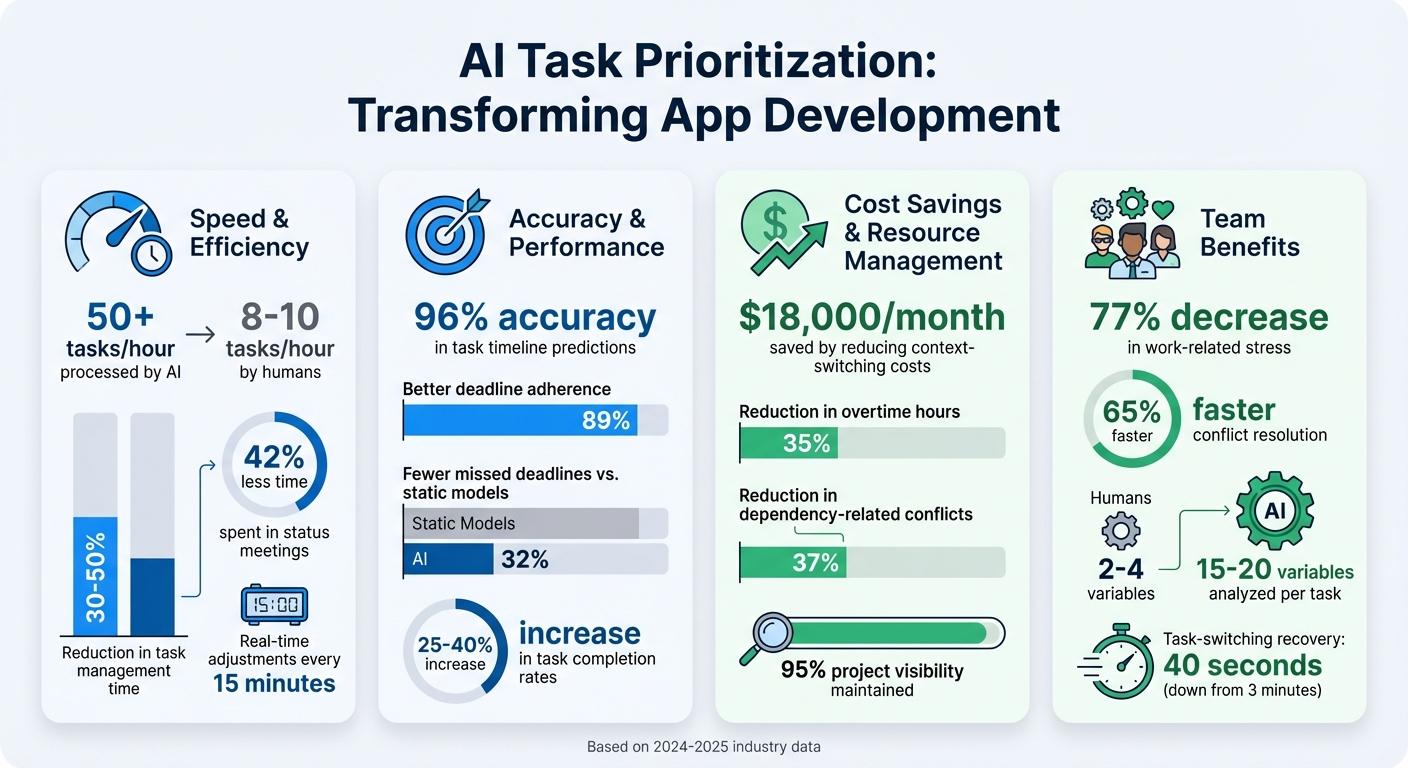
- AI processes 50+ tasks/hour, compared to 8–10 tasks by humans.
- Teams using AI report 89% better deadline adherence and 96% accurate task predictions.
- Automating prioritization cuts 30–50% of time spent on task management and reduces overtime by 35%.
- Real-time adjustments every 15 minutes ensure tasks reflect current project needs.
AI doesn’t just save time - it improves decision-making and reduces errors. By integrating with tools like Jira or Asana and analyzing historical data, AI helps teams avoid context-switching costs (up to $18,000/month) and dependency conflicts (37% reduction). For app developers, this means faster delivery, fewer missed deadlines, and better resource allocation.
5 AI Tools That Will Replace 99% of Project Management Work - AI for Project Managers | PMPwithRay
sbb-itb-622dc24
Main Benefits of AI in Task Prioritization
AI offers three standout advantages for app development teams: automating repetitive tasks, enabling smarter, data-driven decisions, and adapting instantly to changes in real time. These benefits don’t just streamline workflows - they save money. For example, companies report cutting $18,000 per month in costs simply by reducing time lost to context-switching. Teams also spend 42% less time in status meetings, all while maintaining 95% project visibility.
Automating Repetitive Prioritization Work
AI takes over the time-consuming job of sorting, ranking, and assigning tasks, freeing up developers to focus on what they do best - building and problem-solving. This automation slashes 30–50% of the time previously spent on task management.
But it’s not just about speed. AI systems are designed to work smarter. For instance, when a developer approaches 80% of their workload capacity, the system redistributes tasks to prevent burnout. This proactive adjustment has led to a 35% drop in overtime hours for many teams. By automating these processes, teams not only save time but also reduce stress and improve overall efficiency.
Better Decisions with Data-Driven Insights
Beyond automation, AI excels at making decisions based on hard data. It evaluates multiple factors - like urgency, business impact, technical dependencies, and team bandwidth - to assign objective priority scores. These scores are customizable, allowing teams to tweak the system based on their needs. For example, you might set a 40/60 balance between urgency and importance or use a matrix that combines Strategic Value (scored 1–10) with Client Impact (High/Medium/Low).
AI’s predictive abilities are equally impressive. By analyzing historical data and using methods like Monte Carlo simulations, it can forecast task timelines with up to 96% accuracy. It also keeps an eye on technical dependencies by monitoring code repositories, helping teams identify bottlenecks early. In 2024, Siemens adopted AI-driven task mapping and saw a 37% reduction in dependency-related conflicts. Overall, teams using these systems report an 89% improvement in meeting deadlines.
Real-Time Adjustments Based on Project Changes
AI’s ability to adapt in real time ties everything together. Unlike static project plans that might only get updated quarterly, AI recalibrates priorities every 15 minutes. It continuously tracks variables like deadline urgency, resource availability, and new dependencies, reshuffling tasks as needed to reflect the latest conditions.
Some systems even leverage Natural Language Processing to scan communications - like emails, Slack chats, or meeting notes - for urgent updates or delays. This triggers immediate priority adjustments. Thanks to this dynamic responsiveness, teams using AI experience 32% fewer missed deadlines compared to those relying on static models. It’s a game-changer for staying aligned with shifting business goals.
How to Implement AI for Task Prioritization
If you're ready to harness AI for task prioritization, here’s a straightforward approach to integrating it into your app development workflow. The process involves three key steps: linking AI to your project management tools, training it with historical data, and creating feedback loops for ongoing improvement.
Connecting AI with Project Management Tools
Start by integrating your AI platform with tools like Jira, Trello, or Asana using secure API connections. Schedule 15-minute syncs to keep data fresh and accurate. Before going live, standardize naming conventions (e.g., "Project_Context_Action") and use ISO 8601 timestamps for scheduling consistency. Adopt a four-tier priority system - Critical, High, Medium, Low - to ensure uniformity across all tools.
Integration typically takes between two hours and two days, depending on your setup. To safeguard your data, use AES-256 encryption and conduct quarterly security audits.
Training AI Models with Historical Data
Once the tools are connected, the AI needs quality data to learn. Provide at least three months’ worth of historical task data for training. For example, a global software company applied this approach to manage 12,000 monthly tasks across 45 teams. The result? A 25% reduction in critical path delays and over 85% alignment between AI predictions and actual task completions.
AI models can analyze 15–20 variables per task - like historical completion times, team capacity, dependencies, and client priorities - far beyond the 2–4 variables humans typically consider. This depth of analysis allows for smarter, more accurate prioritization.
Setting Up Feedback Loops for Continuous Improvement
Even with a trained model, continuous feedback is essential to keep the AI aligned with your team’s evolving needs. Monitor how often team members override AI-assigned priorities. If overrides exceed 15%, it’s a sign to retrain the model or tweak its rules. Regularly compare the AI’s predictions with actual outcomes to refine its algorithms.
Additionally, set up automated weekly review prompts to collect team feedback on the AI’s effectiveness. Studies show that implementing such feedback loops can improve task completion rates by 25–40%, while maintaining at least 85% alignment between predictions and real-world outcomes.
AI Algorithms That Improve Task Prioritization
AI algorithms like reinforcement learning and predictive analytics play a crucial role in refining task prioritization in app development. These methods power the systems that rank and adjust tasks, each offering distinct ways to tackle prioritization challenges.
Reinforcement Learning for Adaptive Prioritization
Reinforcement learning approaches task prioritization as a sequential decision-making problem. The AI learns by interacting with its environment, receiving rewards for achieving goals like meeting deadlines or completing critical tasks. This trial-and-error process allows the system to continuously improve its recommendations.
"Reinforcement learning (RL) provides a principled mathematical framework to describe how an agent can learn to perform a task by reinforcing its rewarding behaviors." – Dong Wang et al., Tianjin University
Unlike traditional models, reinforcement learning adapts in real time, learning directly from interactions. This makes it especially useful in dynamic environments - like projects with ongoing code changes or shifting dependencies in microservices architectures - where conditions evolve rapidly.
For example, in 2023, researchers utilized model-based reinforcement learning to optimize Android UI testing across 21 industrial apps, some with over 100 million users. The AI agent successfully navigated complex GUI states and interaction sequences, streamlining testing paths. These adaptive methods complement traditional forecasting by responding to changes as they happen.
Predictive Analytics for Task Forecasting
Predictive analytics, on the other hand, relies on historical data to anticipate task outcomes. By analyzing factors like team capacity, sprint metrics, and code commits, these models help set realistic deadlines and identify potential bottlenecks. Using supervised learning, they evaluate numerous variables per task, leveraging comprehensive historical data.
These tools are impressively accurate, with some achieving up to 96% accuracy in predicting task timelines. In one instance, a tech team in early 2025 implemented a priority matrix system that weighed Strategic Value and Client Impact. This led to a 27% drop in missed deadlines and monthly savings of $18,000 by reducing context-switching.
Predictive systems also automate feature prioritization, ranking tasks based on factors like user preferences, market trends, and business impact. They can process over 50 tasks per hour, far outpacing the 8–10 tasks typically handled manually, while maintaining consistent scoring across the backlog. These methods have proven effective in minimizing delays and ensuring smoother feature rollouts in mobile app development.
Reinforcement Learning vs. Predictive Analytics
Each approach has its strengths and is better suited for specific scenarios. Here's a quick comparison:
| Feature | Reinforcement Learning | Predictive Analytics |
|---|---|---|
| Core Mechanism | Sequential decision-making with feedback and rewards | Forecasting based on historical data patterns |
| Adaptability | Highly flexible, adjusts in real time | Moderately flexible, relies on past trends |
| Best Use Case | Dynamic prioritization, test optimization, code completion | Timeline prediction, risk assessment, task forecasting |
| Processing Speed | Learns continuously in real time | Handles 50+ tasks per hour |
| Accuracy | Improves with ongoing feedback | Up to 96% accuracy in stable conditions |
| Data Requirement | Needs real-time interactions and rewards | Requires at least three months of historical data |
| Main Limitation | Needs many interaction samples to perform optimally | Struggles with unexpected changes or rare events |
The choice between these methods depends on the project. In fast-changing environments like microservices or dynamic testing, reinforcement learning excels due to its real-time adaptability. For stable projects where past data can reliably predict future outcomes, predictive analytics delivers high accuracy with less complexity.
Practical Benefits of AI-Driven Task Prioritization in App Development
The earlier discussion on automation, data insights, and real-time adjustments translates into clear, actionable results for app development teams.
Higher Productivity and Faster Time-to-Market
AI-driven task prioritization has a direct impact on productivity and delivery speed. For example, in early 2025, a tech team using Magai's priority matrix - customized for Strategic Value and Client Impact - cut missed deadlines by 27% and saved US$18,000 monthly by reducing context-switching. Similarly, Siemens saw a 37% drop in dependency-related conflicts after adopting AI-driven task mapping in 2024.
Real-time systems that update priorities every 15 minutes have reduced missed deadlines by 32%. Teams leveraging AI feedback loops report a 25–40% increase in task completion rates, while complex tasks see up to a 66% improvement. These gains not only speed up project timelines but also foster stronger team collaboration.
Better Collaboration and Resource Management
AI prioritization reshapes collaboration by providing clear, data-backed priorities, minimizing subjective debates. Teams using AI-driven task organization spend 42% less time in status meetings yet maintain 95% project visibility. Real-time priority sharing also reduces conflict resolution times by 65%.
Resource management benefits as AI monitors workloads in real time. Dynamic task reassignment during peak workloads cuts overtime by 35%. A financial services firm, for example, used machine learning to categorize tasks, reducing parallel task conflicts by 58% while meeting strict SEC compliance deadlines. Additionally, task-switching recovery time drops from 3 minutes to just 40 seconds with AI support, and teams report a 77% decrease in work-related stress thanks to clear daily objectives.
"AI prioritization works best when you clearly define what 'urgent' means through measurable parameters rather than subjective labels." – Dustin W. Stout, Founder, Magai
Appeneure's Experience with AI-Powered App Projects
Appeneure's portfolio of over 100 client projects highlights how AI prioritization drives success in complex app development. Their work spans health tech, e-commerce platforms, and AI-powered applications, all benefiting from AI-driven task prioritization to manage intricate dependencies across frontend, backend, and machine learning workflows.
In e-commerce projects, Appeneure uses AI to prioritize feature rollouts based on user feedback and business metrics. This ensures high-impact features, like payment gateways and personalized recommendations, receive timely attention without constant manual adjustments. By analyzing historical sprint data from past projects - such as fitness, dating, and career guidance apps - the AI predicts accurate timelines for similar tasks in new developments.
For AI-powered apps with conversational agents, Appeneure relies on automated prioritization to focus on critical testing tasks. The system pinpoints conversation flows needing immediate attention based on user interaction trends and error rates, helping resolve issues before they affect the user experience. This method is particularly effective when balancing platform-specific tasks for simultaneous iOS and Android development alongside shared backend work.
Best Practices for Using AI in Task Prioritization
Using High-Quality Data for AI Inputs
Accurate task prioritization with AI starts with clean, well-organized data. Begin by auditing all your task sources - whether they come from project management tools, emails, or spreadsheets - and centralize them into one system. Each task should include a detailed description, effort estimates, assigned team members, deadlines, and relevant tags. To train the AI effectively, use at least three months of historical task data to help the system recognize patterns and trends. A structured data foundation can lead to task recommendations with accuracy levels as high as 92%. It’s also important to record instances where team members override AI suggestions, such as during unexpected client emergencies, as these cases provide valuable insights for refining the model. Strive for an alignment rate of over 85% between AI predictions and actual task completions, while keeping manual overrides below 15%. When your data is solid, the next step is balancing AI insights with human judgment.
Combining AI Recommendations with Human Oversight
Even with high-quality data, human oversight remains a key part of AI-driven task prioritization. A 70/30 hybrid model - where AI handles 70% of the workload and humans oversee the remaining 30% - tends to work well. While AI can process 15–20 variables per task, it may still miss nuances that only humans can understand. To ensure transparency, choose AI tools that clearly explain their prioritization logic. Regular review cycles, such as weekly feedback sessions (e.g., Friday reviews), can help assess the AI’s accuracy. For high-priority tasks (P0/P1), implement automated escalation processes that involve human confirmation, such as SMS alerts triggered after two missed in-app notifications. This blend of automation and human input ensures both efficiency and accountability.
Prioritizing Critical Tasks in Real-Time
Real-time prioritization is essential for addressing critical tasks as they arise. AI systems should include automated escalation protocols tailored to task severity. For example, configure alerts based on urgency: SMS for critical tasks, 30-minute in-app notifications for high-priority items, and daily summaries for medium-priority tasks. A weighted scoring system - factoring urgency (40%), business impact (35%), and technical dependencies (25%) - can help the AI adjust priorities dynamically as blockers are resolved. The system should automatically elevate a task’s priority once its dependencies are cleared. To avoid bottlenecks, dynamic capacity buffering can redistribute tasks when team utilization exceeds 80%. Siemens demonstrated the effectiveness of this approach in 2024, achieving a 37% drop in dependency-related conflicts and an 89% improvement in meeting deadlines by combining real-time AI adjustments with human intervention. This combination allows managers to address critical business needs while leveraging AI’s efficiency.
Conclusion
AI has reshaped how app development teams prioritize tasks, moving away from subjective, manual processes to data-driven systems that evaluate 15–20 variables per task. Instead of relying on intuition or external pressures, teams can now use algorithms capable of analyzing over 50 tasks per hour, dynamically adjusting priorities every 15 minutes based on real-time factors like dependencies, resource availability, and deadlines.
Organizations utilizing AI for task management have reported measurable benefits, including improved adherence to deadlines and noticeable monthly cost reductions by minimizing context-switching. These outcomes highlight how AI lowers the mental burden on developers, allowing them to focus on meaningful coding tasks rather than administrative juggling.
To maximize these benefits, success depends on balancing automation with human insight. A 70/30 hybrid model - where AI manages the bulk of prioritization while humans oversee strategic decisions - ensures both efficiency and accountability. Teams should aim to start with clean, standardized data and establish regular feedback loops to fine-tune the system's accuracy over time.
For teams aiming to stay ahead in app development, adopting AI-driven task prioritization is no longer optional. These tools enable teams to deliver high-quality apps on time. At Appeneure, we’ve embraced these AI-powered approaches in our workflows - especially for our AI-driven app projects - helping clients achieve consistent timelines and superior results. This approach underscores our dedication to combining cutting-edge technology with expert oversight to deliver the best outcomes.
Looking ahead, the future of app development will belong to teams that use AI not to replace human expertise, but to enhance decision-making and streamline their processes.
FAQs
How does AI help prioritize tasks in mobile app development?
AI helps streamline task prioritization in mobile app development by evaluating factors such as deadlines, task dependencies, resource availability, and project objectives. Using real-time data and historical trends, it can adjust task rankings dynamically, ensuring teams focus on the most pressing and impactful work.
This approach driven by data minimizes the need for manual decision-making, improves how resources are allocated, and keeps projects aligned with deadlines. By automating the prioritization process, AI allows developers to work more effectively and produce high-quality apps in less time.
How does AI enhance task prioritization in mobile app development?
AI is transforming how teams handle task prioritization in mobile app development. By automating the organization process, it not only saves time but also streamlines project management. AI can evaluate factors like urgency, task dependencies, and deadlines in real time, helping teams adapt swiftly when priorities shift.
The benefits go beyond just saving time. AI enables developers to make more precise decisions and significantly boosts productivity. For example, tools powered by AI can cut manual planning time by up to 50% while improving adherence to deadlines by nearly 90%. This leads to smoother workflows and smarter use of resources, ensuring teams can deliver high-quality apps without delays.
How can teams integrate AI into their project management tools for better task prioritization?
Bringing AI into project management tools can simplify how tasks are prioritized by automating data analysis and decision-making. By integrating AI with platforms like Jira, Trello, or Monday.com, teams can benefit from real-time updates and adjustments. These systems adapt dynamically to factors such as deadlines, team workload, and task dependencies, making project management more efficient.
To get the most out of AI, it's important to standardize data inputs. This means clearly defining task labels and project details to ensure the AI processes information accurately. Features like automated updates, priority recommendations, and real-time alerts help reduce manual work, enabling teams to respond to changes faster and stay productive. The key to success lies in setting up these tools correctly and continuously fine-tuning them for your team’s needs.
More from the studio